

Cultivated meat is no longer being judged on science alone. It now lives or dies on cost, trust, product choice, partnerships and cash flow.
If I boil the article down, the message is simple: the sector has moved from hype to hard business maths. Global investment fell to US$74 million in 2025, down about 96% from the 2021 peak. And even companies with approvals have still shut down. So the founders still in the race are the ones building around low costs, simple first products, staged market entry, partner networks and near-term revenue.
If you want the short version, here it is:
- Build for cost first. If unit economics only work at huge scale, the model is shaky.
- Treat regulation as part of product design. Simpler products and lower-friction markets can cut delay.
- Make food people already know how to buy and cook. Burgers, mince and hybrid products are easier than whole cuts.
- Do not try to build everything alone. Facilities can cost US$325 million to US$1.2 billion.
- Keep the mission, but change the route. Pet food, ingredients and food service can bring in early sales.
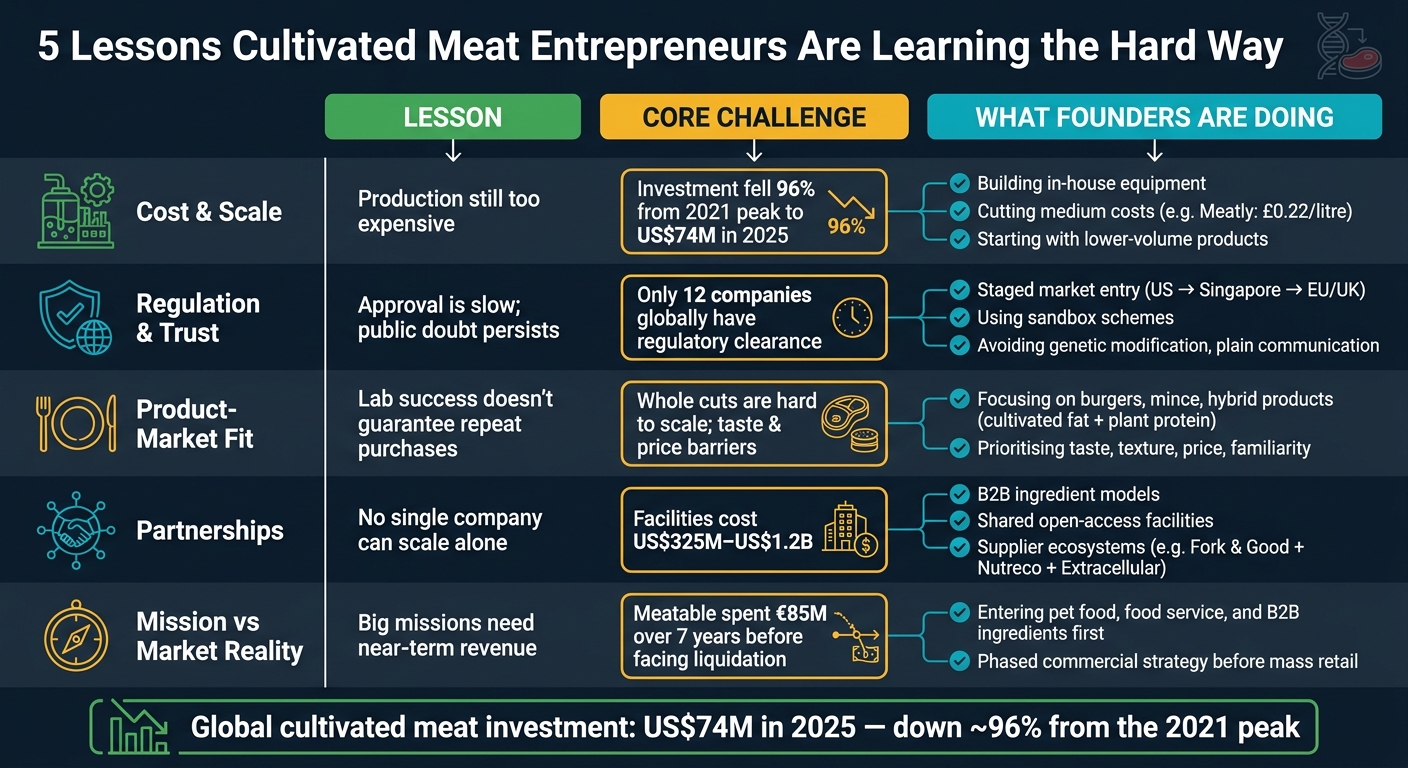
5 Lessons Cultivated Meat Entrepreneurs Are Learning the Hard Way
The winter before spring: The cultivated meat story | Ahmed Khan | TEDxLondonBusinessSchool

sbb-itb-c323ed3
Quick comparison
| Lesson | Main issue | What founders are doing |
|---|---|---|
| Cost and scale | Production is still too expensive | Cutting culture medium costs, building in-house equipment, starting with lower-volume products |
| Regulation and trust | Regulatory approval is slow and public doubt is still there | Entering easier markets first, using sandbox schemes, keeping communication plain |
| Product-market fit | Lab success does not mean repeat purchases | Focusing on taste, texture, price and familiar formats |
| Partnerships | Scale is too expensive for one company | Working with suppliers, shared plants and B2B partners |
| Mission vs market reality | Big goals need a path to revenue | Starting with fats, hybrids, pet food and food service |
My take: this is now a food manufacturing story, not just a biotech story. The winners will not be the firms with the boldest claims. They will be the ones that can make something safe, affordable and easy to sell.
That is the thread running through all five lessons.
What founders have learned about building a new meat category
The hardest lesson is commercial: Cultivated Meat works only if it can be produced safely, cheaply and at industrial scale.
As Max Jamilly, Co-founder and CEO of Hoxton Farms, put it:
"The companies that recently shut down didn't do so because the science failed, but because their business and manufacturing models didn't translate to scalable, cost-efficient production." - Max Jamilly, Co-founder and CEO, Hoxton Farms [4]
That same pattern showed up again in 2024 and 2025. Believer Meats stopped operations in late 2025 even after winning FDA and USDA approval and beginning work on a facility in North Carolina built to make 12,000 tonnes of cultivated chicken a year. [2][4] The point is simple: proving the science is not the same as building a business that works.
Cultivated Meat is hard because it sits in an awkward middle ground. It needs the precision and sterile conditions of pharmaceutical manufacturing, but it also has to survive on the slim margins of commodity food. Cells do not scale like software. As bioreactor designs get larger, cost, risk and complexity grow with them. [1]
Christie Lagally, Founder and CEO of Rebellyous Foods, said it plainly:
"Profitability and scale must be designed into product level unit economics from the outset. If margin is only coming from massive scale, success is tenuous." - Christie Lagally, Founder and CEO, Rebellyous Foods [3]
That is why the first lesson is to build for cost and scale from day one.
1. Focus on cost and scale from day one
This lesson shows up most clearly in how founders cut costs. Funding has dropped hard since 2021, so investors now want proof of profit, not just a good story.
London-based startup Meatly is one of the clearest examples of what cost-first building looks like in practice. By 2024, the company had cut its growth-medium costs to £0.22 per litre and reduced bioreactor costs tenfold by making its own equipment. In May 2026, Meatly closed a £10.4 million Series A to build a 20,000-litre bioreactor facility - the largest in Europe - with the UK pet food market as its first commercial step [7][8].
That matters because cost discipline sits underneath everything else: safety, approval and trust. If the economics don’t work early on, the product won’t get far.
"Success in this category ultimately comes down to one thing: bringing down the cost of production. The team at Meatly has consistently cracked this challenge, reducing costs by building their own bioreactors [and] developing their own culture medium." - Jim Mellon, Chairman, Meatly [8]
The business takeaway is simple: sort out the economics before you sort out the final product. In practice, that means starting with ingredients used in small amounts and building cost-efficient bioprocesses from the beginning. It also means going after low-volume, high-value products first, such as cultivated fats blended with plant proteins.
Once the cost model works, the next hurdle is trust.
2. Build regulatory and public trust step by step
Getting a Cultivated Meat product approved for sale is slow. As of early 2026, only 12 active companies worldwide had received some form of regulatory clearance to sell Cultivated Meat across six countries and the EU [4]. So it makes sense that founders usually start with the path that looks least risky.
One common move is staged market entry. Companies like BlueNalu are starting in the US and Singapore first, then aiming for the EU and UK. That sequence helps them scale without taking on too much regulatory risk too early. Lou Cooperhouse, BlueNalu's founder and CEO, puts it plainly:
"Regulatory timelines ultimately rest with authorities, but we've prioritised transparency, data rigour, and constructive engagement throughout the process." - Lou Cooperhouse, CEO, BlueNalu [4]
In the UK, the Food Standards Agency's Cultivated Meat sandbox programme gives companies a way to work through safety, scale and feasibility before making a full submission. Hoxton Farms is one of the businesses taking part [9][4].
Regulatory planning also affects the product itself. Mosa Meat has steered clear of genetic modification to cut friction, and its early focus on cultivated fat lowers regulatory risk while making the first product feel less daunting to buyers. Put simply, simpler product formats mean fewer approval hurdles and less consumer hesitation [1].
Trust isn't built by paperwork alone. It also comes from how companies talk to the public. Steady, honest communication matters more than hype, especially in a field where one setback can be blown out of proportion. Harsh Amin, CEO of Ivy Farm Technologies, said it well:
"The risk is that individual setbacks are misread as systemic failure. Clear communication is critical. Cultivated meat is a long game, but it's a necessary one." - Harsh Amin, CEO, Ivy Farm Technologies [4]
That slow, steady trust-building is what helps consumer adoption move forward, not just the regulatory green light.
3. Design products around what consumers actually want
Technical progress means very little if the product never makes it onto someone’s plate. That’s why founders are putting taste, texture, familiarity and price at the centre of their first launches.
One clear move is the push towards hybrid products: plant-based proteins paired with cultivated fat. The logic is simple. If you can improve the eating experience without trying to build a full product from scratch, you have a better shot at winning people over. Mark Post, Chief Scientific Officer at Mosa Meat, puts it like this:
"It brings with it a natural meat taste that you would otherwise have to recreate with a fairly large number of ingredients to make a plant-based hamburger taste like meat." - Mark Post, CSO of Mosa Meat [6]
Cultivated fat can improve flavour, juiciness and cooking performance in ways vegetable oils struggle to match. That’s exactly why Hoxton Farms, based in London, opened a pilot facility in 2024 to scale cultivated pork fat production.[5]
Early launch formats tend to be burgers, sausages and mince. That makes sense: people already know how to cook them, serve them and fit them into everyday meals. Whole cuts are much harder to produce, so many founders are starting with products that feel familiar and easier to bring to market.
Price, of course, is still a sticking point. But founders are clear that Cultivated Meat cannot remain a niche product aimed at a tiny group of buyers. As Mark Post says:
"The price of cultivated meat will be reasonable. It will not be so exclusive that only a happy few can pay for it." - Mark Post, CSO of Mosa Meat [6]
Those product decisions also affect which partners companies need if they want to produce and sell at scale.
4. Partner across the value chain rather than go it alone
Scaling Cultivated Meat takes more than a good product idea. It takes shared infrastructure, specialist suppliers, and route-to-market partners. No Cultivated Meat company can scale on its own. The numbers make that plain: facilities able to produce between 4,000 and 25,000 tonnes a year are estimated to cost between $325 million and $1.2 billion [10]. That kind of spend puts pressure on any founder. Shared infrastructure and supplier partnerships help cut that capital risk.
The sharpest founders are building ecosystems instead of trying to do everything under one roof. In early 2026, Fork & Good announced strategic partnerships with Nutreco and Extracellular to build a cost-efficient manufacturing process for Cultivated Meat products [4]. It’s a simple idea, but a powerful one: bring in the right partners, and you don’t have to carry the whole load yourself.
Another case is Cultivate-at-Scale, a spin-out of Mosa Meat. It launched an open-access facility in Maastricht, backed by the Dutch National Growth Fund, with single-use bioreactors of up to 1,000 litres to help multiple companies optimise their processes and support market validation [10]. That matters because shared facilities give founders room to test, refine, and de-risk production before committing to full-scale plants. In plain terms, it’s a way to learn first and spend later.
"Collaboration is no longer a nice-to-have; it's a necessity. The companies with the best ecosystem of partners will have the best chance of pulling off the jump to commercialisation." - Niya Gupta, Co-founder and CEO, Fork & Good [4]
Partnerships also matter on the commercial side. Mission Barns is using a B2B partnership model, selling its "Mission Fat" to other food manufacturers so they can create hybrid meat products, instead of trying to build and scale a full consumer line on its own [4]. That’s a practical route. It means lower volumes, and it can also mean less regulatory friction.
"Companies that succeed will be those that demonstrate the right product strategy, operational discipline, credible and transparent profitability pathways, and strong partnerships across the value chain." - Didier Toubia, co-founder and CEO of Aleph Farms [4]
That mix of collaboration and discipline sets up the next lesson: staying mission-driven while adjusting to market reality.
5. Stay mission-driven while adjusting to market reality
The hardest part is balancing mission with the short-term calls needed to keep the business alive. Funding pressure speeds everything up. It forces harder choices, earlier.
Founders are moving from early optimism to commercial reality. Many have shifted to "ingredients-first" strategies, using cultivated fats or other functional components (a key application of cultivated meat technology) to improve plant-based products at lower volumes and with fewer regulatory hurdles [1][4]. Put simply, it’s a practical way to stay close to the mission while cutting risk. As Wouter de Heij, CEO of TOP b.v., put it:
"It is a marathon technology being funded like a sprint." [1]
That change affects what founders launch first and how they go to market.
Meatable is a clear case. Technical progress means little if the funding model can’t carry the business through a longer path to market. The Dutch startup spent about €85 million over seven years before facing liquidation in late 2025, when its lead investor, Agronomics, withdrew support [1]. The science was strong. The commercial path wasn’t.
Meatly shows a more practical route. Instead of going straight after the mass consumer market, it entered through pet food, where regulatory barriers are lower and early revenue is easier to reach. It had already sold the world's first Cultivated Meat pet food in 2025 after receiving UK regulatory approval [11]. That’s mission-driven thinking in practice: prove the model, bring in revenue, then scale. The same logic shapes pricing, regulation, and route to market strategies.
Didier Toubia, co-founder and CEO of Aleph Farms, summed up the new reality:
"The industry has moved past its early hype cycle and is now judged on execution, risk management, and consumer relevance rather than vision alone." [4]
In practice, mission only works if the business survives long enough to deliver on it.
The cost and scale challenge behind lesson 1
The 2013 Mosa Meat burger made one thing plain: Cultivated Meat still had a huge cost and scale problem.
That burger was hand-built from 10,000 muscle strands over three months in a university lab. It proved the idea could work. But it was proof of concept, not anything close to a production system. That gap helps explain why founders have spent so much time on the biggest cost pressures first, especially growth medium and equipment.
Growth medium - the nutrient-rich liquid that feeds cells as they multiply - has long been one of the biggest cost inputs. Recombinant proteins sit in that same camp, though their cost has dropped 1,000-fold since the industry's inception [6]. Equipment has moved in the same direction. Meatly, for example, cut bioreactor costs tenfold by making its own systems in-house [7].
Then there are the extra costs that don’t go away just because the science works on paper. Contamination risk is always hanging over the process, and sterile, temperature-controlled sites use a lot of energy. In the UK, where industrial electricity prices are a serious issue, that matters [1][7].
Scale creates another headache. Once systems go above 10,000 litres, cells become harder to control. And if contamination happens at that size, you can lose the whole batch. As Wouter de Heij, CEO of TOP b.v., noted:
"Cultivated meat sits somewhere between pharmaceutical bioprocessing and commodity food manufacturing - and inherits the disadvantages of both." [1]
That leaves founders with a tough choice. They can back large stainless-steel bioreactors built for long-term scale, or they can use modular in-house systems that cut upfront cost and lower technical risk.
Once the economics start to shift, the next hurdle is safety - and whether the public is willing to trust it.
How regulatory approval and public trust are built over time
Cultivated Meat approval takes years. It affects product design, launch timing, and how much cash a company needs to get to market. For founders, regulation isn't some admin job sitting off to the side. It's a product decision from day one.
In the United States, the FDA and USDA handle a joint review process. As of early 2026, five products - including chicken, salmon and pork fat - had received some form of regulatory clearance [9]. Three of those approvals came in 2025 alone [9]. That matters. It suggests that as regulators and companies get used to the process, later approvals may move with less delay [9]. It also helps explain why some companies target one market before another.
In the UK, the route goes through the Food Standards Agency (FSA) and the novel foods framework. In December 2025, the UK released its first specific guidelines on Cultivated Meat novel food applications [2]. Around the same time, the FSA's sandbox programme - backed by £1.6 million in government funding - began helping companies like Hoxton Farms sort out what regulators need before a formal submission goes in [4] [12].
Some founders also steer clear of genetic modification to cut regulatory friction, especially in Europe [1]. It sounds like a small early choice. In practice, it can save a lot of time later.
Public trust tends to grow in much the same way: slowly, through transparency and repeated contact. Robin May, the FSA's chief scientific adviser, has been direct about why this process takes time:
"You've got these two extremes of great familiarity and massive novelty in one product. And for that reason, we are very much of the view that this is a product class that is going to take some serious thought." - Robin May, Chief Scientific Adviser, Food Standards Agency [12]
That caution is deliberate. The aim is to avoid the kind of public backlash that derailed GM foods in the 1990s [12]. And in a very practical sense, these approval choices affect which products founders decide to launch first.
Why product-market fit matters as much as technical progress
Getting the science to work is only half the job. Founders also need to make something people will buy, cook and eat more than once. That means thinking hard about format, flavour, and how a product fits into everyday meals. Put simply, format choice matters just as much as process choice.
A lot of teams are leaning into formats that already match how people shop and cook. Whole cuts are still harder to produce at scale because they need more complex tissue structure [5][6]. Mince and burgers are a much easier fit. They work in home cooking, sit neatly in current retail supply chains, and don’t ask shoppers to change their habits overnight.
Fat sits right at the centre of this. It drives browning, aroma and juiciness - much of what makes meat satisfying in the pan and on the plate. Ivy Farm Technologies is taking a pragmatic approach with cultivated beef, prioritising taste, nutrition, and safety, cost, and trust before launch [4]. That kind of focus matters. It shows a company is thinking less about what looks good in the lab and more about what will make sense to customers.
The market is also moving towards hybrid formats, blending cultivated cells or fats with plant proteins. At this stage, success depends on culinary quality, clear consumer value, and a credible path to scale [4].
Partnerships that make scaling possible
Once the product strategy is set, the next step is figuring out who helps build it and get it into market. Scaling leans on partners that cut cost, lower risk, and speed up launch. No Cultivated Meat company can do this on its own. The science, challenges, and solutions are specialised, capital needs are high, and approvals take time, so collaboration matters more than trying to control every part of the process.
A lot of this comes down to the supply chain. Orf Genetics, for example, supplies growth factors made from bioengineered barley to companies such as Mosa Meat and Vow. That kind of specialist supplier relationship has helped bring down the cost of key growth-medium inputs [6].
Many founders are also leaning towards a B2B ingredients model instead of going straight to consumers. London-based Hoxton Farms, co-founded by Max Jamilly, focuses on cultivated pork fat and works with food manufacturers rather than selling direct to shoppers. It opened a dedicated pilot facility to show B2B partners that its product can be made at scale, and it partnered with Sumitomo to bring its ingredients into Asian supply chains [5].
That ecosystem approach matters. A specialist supplier, a B2B route to market, and shared infrastructure can help founders lower capital risk and move towards commercialisation faster.
The same partner discipline also shapes the commercial trade-offs founders must make next.
Balancing long-term mission with near-term commercial decisions
That partnership logic only goes so far. Founders still need a route to market that works in practice. And right now, Cultivated Meat founders are under pressure to turn big ambition into actual cash flow. So most aren’t betting on one big launch. They’re taking a phased approach instead.
A common starting point is premium food service. It lets companies keep volumes under control, support higher prices, and build trust before trying to reach supermarket shelves. In practice, that means many founders are starting with pet food, B2B ingredients, and premium food service first, with broader retail coming later.
The trade-off is pretty clear: the routes with the clearest near-term revenue often sit furthest from the original mission. Early commercial wins only matter if they help move the business towards broad adoption over time.
"The companies that will succeed are those that demonstrate culinary quality, a short-term pathway to both scalability and profitability, and products that can demonstrate a significant value proposition and market fit." - Lou Cooperhouse, Founder and CEO, BlueNalu [4]
Conclusion
Put simply, the five lessons lead to one clear point: Cultivated Meat is now as much a business problem as a science problem.
Taken together, these lessons show that Cultivated Meat will scale only if founders get comparing costs, regulation, product design, partnerships and commercial strategy right at the same time.
What matters now is execution. Understanding the roadmap for cultivated meat is essential for navigating this transition. The founders still moving forward are showing that progress comes from disciplined work, not hype.
FAQs
Why is cost still the biggest barrier?
Cost is still the biggest barrier. Cultivated Meat production needs heavy upfront investment, costly growth media, and slow, complex biological scaling. Put those together, and large-scale manufacturing becomes hard to do at a price that makes commercial sense.
Why are hybrid products launching first?
Hybrid products are launching first because they cost less and take less time to make.
By mixing cultivated fats or other cultivated ingredients with plant proteins, they help deal with two big hurdles: price and scale.
Which markets are easiest to enter first?
The easiest markets to enter first are the ones where approvals are already in place. That includes Singapore, where cultivated chicken is already on sale, and the UK, where schemes such as the FSA’s sandbox are helping companies get to market.


