

Hybrid cultivated meat combines animal cells with plant-based proteins, making it more affordable and quicker to produce. This efficiency is a key factor in the bioreactor vs traditional methods cost comparison. It's ideal for products like burgers and nuggets. Pure cultivated meat, made entirely from animal cells, aims to replicate the taste and texture of conventional meat, especially in cuts like steaks, but is more expensive and complex to produce.
Quick Comparison
| Feature | Hybrid Cultivated Meat | Pure Cultivated Meat |
|---|---|---|
| Ingredients | Cultivated cells + plant proteins | 100% cultivated animal cells |
| Cost | Lower | Higher |
| Texture | Enhanced with plant proteins | Replicates cuts like steaks |
| Formats | Burgers, nuggets, sausages | Steaks, fillets, whole cuts |
| UK Availability | Likely sooner | Longer timeline, premium focus |
Hybrid meat is expected to hit UK markets first due to lower costs and simpler production, while pure cultivated meat will likely debut in high-end restaurants before retail availability.
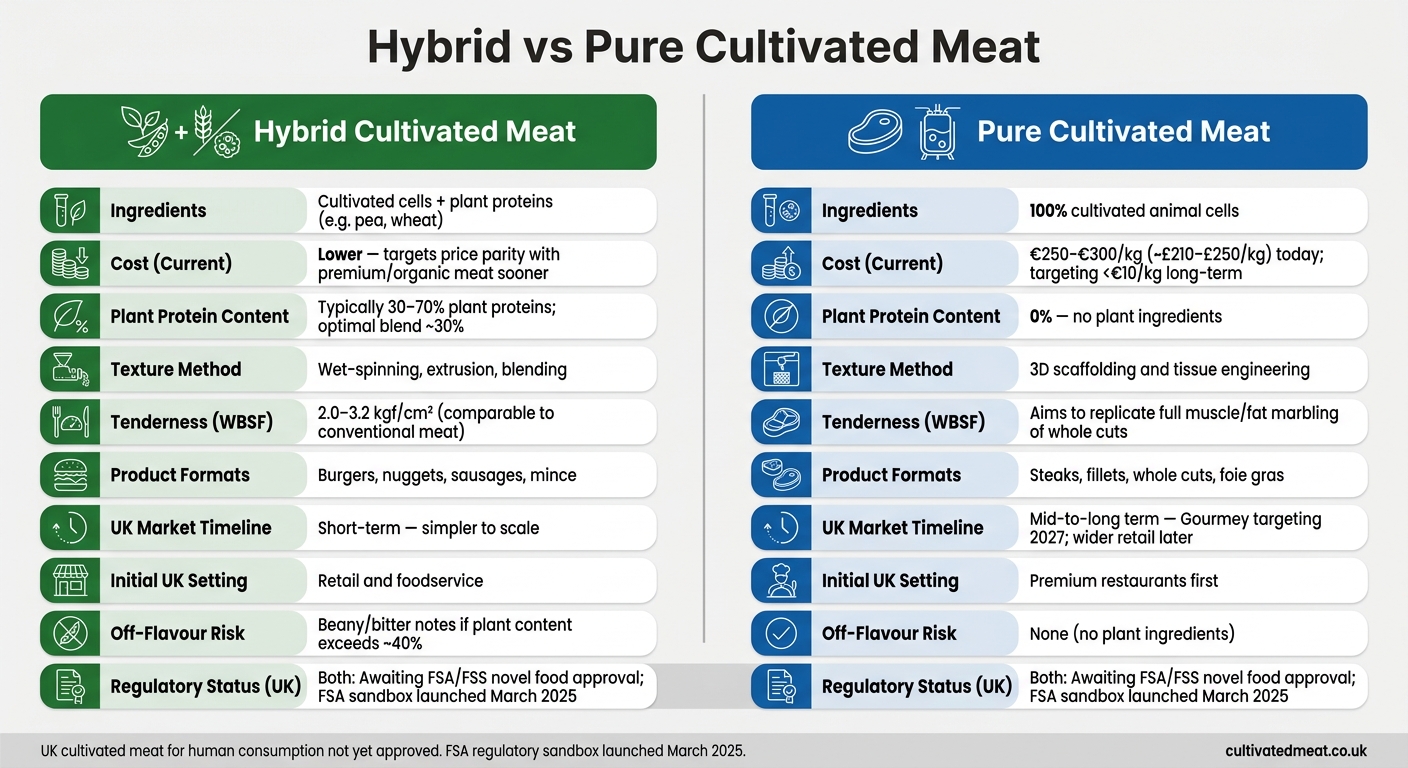
Hybrid vs Pure Cultivated Meat: Key Differences at a Glance
How Hybrid and Pure Cultivated Meat Are Made
How Hybrid Cultivated Meat Is Made
The process for both hybrid and pure cultivated meat starts the same way: isolating animal cells and multiplying them in bioreactors filled with a nutrient-rich medium. Hybrid cultivated meat takes a different path by incorporating plant-based proteins, such as pea or wheat, along with binders like sodium alginate.
This mixture undergoes a wet-spinning process, where it's extruded through a needle into a calcium chloride bath. This step creates fibres that mimic the texture of real muscle. These fibres can then be bundled together and wrapped with membranes to resemble cuts of meat. For simpler products like burgers or nuggets, the cultivated cells are mixed with plant proteins through blending or heat processing. Typically, blends with around 30% plant proteins strike a good balance between cost and a meaty texture. However, going beyond 40% can negatively affect texture, flavour, and even the colour of the product [4].
On the other hand, pure cultivated meat skips the use of plant proteins entirely, aiming to replicate the structure of traditional meat using only animal cells.
How Pure Cultivated Meat Is Made
Pure cultivated meat follows a similar initial process but focuses on growing fully developed muscle and fat tissues. The aim is to recreate the structure of conventional meat cuts, complete with marbling, without blending in plant-based components.
Mark J. Post, Co-founder and Chief Scientific Officer of Mosa Meat, explains:
"The philosophy among cultivated meat pioneers was to offer consumers a product identical to conventional meat... Achieving this was thought to require not only 'pure' products but also high-quality ones composed of fully mature muscle and fat tissue." [2]
To achieve this, scientists co-culture myocytes (muscle cells) and adipocytes (fat cells) on 3D scaffolds. These scaffolds help shape and mature the tissue to resemble traditional meat. However, solving taste challenges in cultivated meat remains a significant hurdle. In conventional meat, much of the taste develops during post-mortem ageing, driven by enzyme activity and pH changes - something that doesn’t naturally occur in a bioreactor [6]. Additionally, scaling up production while keeping the cells healthy is another significant technical hurdle [5].
sbb-itb-c323ed3
Product development in cultivated meat: Why hybrid products will likely be the first step to market
Taste and Eating Experience
How cultivated meat is produced has a direct impact on its taste and texture, shaping the overall eating experience.
Taste and Texture of Hybrid Cultivated Meat
Hybrid cultivated meat combines plant-based proteins with cultivated cells to create a unique product. The plant proteins provide the structure, while the cultivated cells contribute the authentic meat flavour. These cells contain amino acids, sugars, and phospholipids, which release a meaty aroma during cooking. This combination results in a product that tastes closer to real meat than plant-based alternatives, without the need for artificial flavour enhancers.
The texture of hybrid meat depends on the ratio of its components. Studies on hybrid chicken products show that increasing the proportion of cultivated meat tissue to 30% enhances richness, reduces sourness, and improves structural integrity. Tenderness also sees a boost, with wet-spun hybrid chicken achieving Warner-Bratzler shear force (WBSF) values between 2.0 and 3.2 kgf/cm² - a range comparable to conventional meat [1]. However, higher levels of plant proteins can introduce a beany or bitter taste. Keeping plant protein content around 30% strikes a balance between cost and flavour [2][4].
| Feature | Detail |
|---|---|
| Flavour Source | Cultivated cells provide umami and aroma; plant proteins add structure [1][2] |
| Texture Mechanism | Techniques like wet-spinning or extrusion create a fibrous scaffold [1] |
| Tenderness | WBSF values of 2.0–3.2 kgf/cm², similar to conventional meat [1] |
| Common Formats | Burgers, nuggets, sausages, and minced meat [1][4] |
| Off-flavour Risk | Beany notes may arise if plant content exceeds about 40% [4] |
On the other hand, pure cultivated meat focuses entirely on replicating the structure and taste of traditional meat.
Taste and Texture of Pure Cultivated Meat
Pure cultivated meat skips plant-based components entirely, relying instead on mature cell cultures to mimic the complex taste and texture of traditional meat. Using advanced techniques like 3D scaffolding and tissue engineering, it aims to recreate aligned muscle fibres, natural fat marbling, and the distinctive bite of whole cuts. This makes it particularly suited for products like steaks and fillets, which plant-based ingredients struggle to replicate [2].
The potential of pure cultivated meat was first demonstrated in 2013 with the unveiling of a cultivated hamburger. While its flavour was recognisably meaty, its production cost was a staggering £215,000 per patty [2]. Since then, efforts have focused on refining the flavour and replicating the intricate tissue structure of conventional meat, though this remains a challenging task.
| Feature | Detail |
|---|---|
| Flavour Source | Fully differentiated muscle and fat cells [2] |
| Texture Mechanism | 3D scaffolding and tissue engineering techniques [2] |
| Target Formats | Whole cuts like steaks, fillets, and chops [2] |
| Off-flavour Risk | None, as no plant ingredients are used |
| Replication Goal | Achieving a 1:1 match with conventional meat's taste and texture [2] |
Price and Affordability for UK Consumers
When it comes to price, the difference between hybrid and pure cultivated meat becomes particularly evident - and it’s a key factor for UK shoppers. The production methods behind these products play a big role in shaping their costs.
What Influences the Cost of Hybrid Cultivated Meat
Hybrid cultivated meat is more affordable because it combines cultivated cells with plant-based proteins. By using 30% to 70% cultivated cells and filling the rest with plant proteins and binders, manufacturers can take advantage of well-established, cost-effective plant supply chains. This reduces the need for expensive bioreactor runs and large amounts of growth media, simplifying production.
"Hybrid meat offers lower recipe costs... with the availability of livestock set to decline and the price of meat and fish already rising, it provides them with a clear, cheaper alternative." - Niels E. Hower, Executive Board Member, Beneo [4]
| Cost Factor | How It Affects Price |
|---|---|
| Ingredient blend | Combines 30–70% cultivated cells with less expensive plant proteins |
| Production complexity | Uses undifferentiated cells, avoiding costly differentiation stages |
| Infrastructure | Utilises existing plant-based processing equipment |
| Price outlook | Likely to match premium meat prices in the short term |
This cost structure makes hybrid cultivated meat a more accessible choice for UK shoppers compared to pure cultivated meat. It’s expected to reach price parity with premium or organic meat sooner, making it an appealing option for flexitarians and those curious about trying alternatives.
What Influences the Cost of Pure Cultivated Meat
Pure cultivated meat, on the other hand, relies entirely on cultivated cells, which drives up its production costs. Every gram of the product is made from cultivated cells, requiring significant amounts of growth media and complex production systems. Currently, first-generation batch production costs range from €250–€300 per kg (approximately £210–£250 per kg), far beyond what most shoppers would consider affordable.
To bring costs down, the industry is looking to continuous manufacturing through perfusion technology. A 2024 study in Nature Food led by Yaakov Nahmias from Believer Meats and The Hebrew University of Jerusalem highlighted how a 50,000-litre continuous manufacturing facility, combined with an animal-free growth medium costing just $0.63 per litre, could reduce the price of cultivated chicken to about $6.20 per lb (around £4.85 per lb). This would bring it closer to the cost of organic chicken [7].
"The cost of cultivated chicken can drop to within the range of organic chicken at US$6.2 lb⁻¹ by using perfusion technology." - Nature Food [7]
Second-generation systems aim to bring costs down to under €10 per kg (around £8.40 per kg). However, scaling bioreactors beyond 10 cubic metres remains a significant hurdle, which could keep pure cultivated meat at a premium price for longer. For now, pure cultivated meat is more of a niche product, with affordability improving gradually as technology and production methods advance.
Availability and Formats in the UK
Where Cultivated Meat Is Available Now
Cultivated meat has begun reaching consumers in various parts of the world. Singapore led the way in 2020, becoming the first country to approve cultivated meat for consumption [9]. The United States followed in June 2023, with Upside Foods and Good Meat receiving final USDA approval to sell cultivated chicken, initially offered in select restaurants [9]. Israel joined the list in January 2024 when the Ministry of Health approved Aleph Farms' "Aleph Cuts" Petit Steak, marking its first cultivated beef product [9]. More recently, in June 2025, Australia and New Zealand introduced a formal legal framework to regulate cultivated meat [10].
In the UK, however, cultivated meat for human consumption has yet to gain approval. The closest development so far has been in pet food. In July 2024, Meatly, a startup, became the first company in Europe authorised to sell cultivated chicken meat for pets [14]. For human food, progress is underway: in March 2025, the Food Standards Agency (FSA) and Food Standards Scotland (FSS) launched a regulatory sandbox with £1.6 million in government funding. The FSA anticipates receiving around 15 applications from cultivated meat producers over the next two years [8].
"Market authorisation doesn't mean that we're going to be able to buy it in every Tesco in the country from day one. I think what we've seen in other jurisdictions is a very slow, incremental rollout, particularly in foodservice settings." - Linus Pardoe, Senior UK Policy Manager, Good Food Institute Europe [11]
A major step forward came in July 2025, when French company Gourmey became the first cultivated meat producer to achieve validation under the UK's new novel food process. Gourmey aims to introduce its cultivated foie gras to UK consumers by 2027 [12]. If this timeline holds, it’s likely that the first human-grade cultivated meat products in the UK will appear in restaurants before reaching retail shelves. Consumers can follow updates on these developments through platforms like Cultivated Meat Shop, which tracks regulatory progress and product launches.
These regulatory advancements highlight the differences in product types and the timelines for launching hybrid and pure cultivated meat products.
Product Formats for Hybrid and Pure Cultivated Meat
The global rollout of cultivated meat has shown that product formats and launch schedules can vary significantly. Hybrid products - such as nuggets, burgers, sausages, and mince - are expected to hit the market first. These products blend small amounts of cultivated meat or fat (typically 5% to 15%) with plant-based proteins, enhancing both flavour and texture. This approach provides a practical entry point for manufacturers and offers consumers familiar, approachable options [12].
Pure cultivated products, on the other hand, include structured cuts like fillets, steaks, and whole-muscle pieces. These are more challenging to produce due to the need for advanced scaffolding techniques to replicate the complex structure of animal muscle tissue. As a result, these products are likely to debut in high-end restaurants before becoming widely available in retail. For example, Upside Foods introduced its textured chicken cutlet, made from over 99% chicken cells, at Bar Crenn in San Francisco in 2023 [13].
| Format | Type | Expected Timeline for UK |
|---|---|---|
| Nuggets, burgers, mince | Hybrid | Short-term – simpler to scale |
| Sausages, fish sticks | Hybrid | Short-term – established processing methods |
| Foie gras, delicacies | Pure | Mid-term – Gourmey targeting 2027 [12] |
| Fillets, steaks, whole cuts | Pure | Longer term – complex production required |
Conclusion
The choice between hybrid and pure cultivated meat comes down to factors like cost, product format, and the eating experience they offer. For those new to the technology, understanding the basics of cultivated meat is a helpful starting point.
Hybrid cultivated meat, such as nuggets, burgers, mince, and sausages, combines a smaller amount of cultivated cells with plant-based ingredients. This approach helps lower costs, speeds up production, and provides products in familiar formats - ideal for early consumer adoption in the UK market.
As noted in UK government research, "price and taste/enjoyability are reliable predictors of acceptability" [3]. This makes hybrid products a strong contender for meeting both affordability and taste expectations right from the start.
On the other hand, pure cultivated meat focuses on replicating the premium texture and rich flavour of traditional meat, particularly in whole cuts like fillets and steaks. However, creating these structured cuts requires more advanced techniques, which increases costs and lengthens production timelines. As a result, these products are more likely to debut in high-end restaurants before becoming accessible in supermarkets.
| Hybrid Cultivated Meat | Pure Cultivated Meat | |
|---|---|---|
| Cost | Lower | Higher |
| Formats | Familiar retail options | Premium cuts |
| UK timeline | Earlier | Later |
| Initial setting | Retail and foodservice | Premium restaurants |
These differences highlight the cultivated vs traditional meat trade-offs in production, taste, and affordability discussed earlier. For updates on regulatory progress, new product launches, and industry trends, visit Cultivated Meat Shop. Stay informed as hybrid and pure cultivated meat products make their way to UK consumers.
FAQs
Is hybrid cultivated meat still “real meat”?
Hybrid cultivated meat blends cultivated meat with plant-based proteins, aiming to improve taste, texture, and cost. These products contain animal-grown cells, delivering the flavour and nutritional profile of conventional meat, providing a genuine meat experience. At Cultivated Meat Shop, you can explore both pure cultivated meat and hybrid choices to find what aligns with your taste and dietary needs.
Which will reach UK supermarkets first, and when?
Cultivated meat hasn’t made its way to UK supermarket shelves just yet. The current trajectory indicates it’s likely to launch in select restaurants first. This approach helps manage costs and gather feedback from diners. If everything moves smoothly through the regulatory process, we might see these products available by 2027. For more information and updates, visit Cultivated Meat Shop and sign up to stay in the loop.
Why are whole cuts like steaks harder to make than burgers?
Creating whole cuts, such as steaks, is a tougher task compared to making burgers. Why? Steaks demand a precise arrangement of muscle fibres, connective tissue, and fat to mimic the natural marbling found in traditional cuts of meat. Burgers, on the other hand, don't require this level of structure since the muscle is already broken down during processing.
To achieve this level of detail, advanced methods like edible scaffolds and bioprinting come into play. These technologies help replicate the intricate textures and composition needed for a steak. Another challenge is growing thicker tissues. Unlike thin layers, thicker cuts need an even distribution of nutrients and oxygen throughout the tissue - a problem that remains a significant obstacle for current cultivated meat technologies.


