

Cultivated meat is being shaped by government policies worldwide. These policies influence how quickly products reach consumers, where they are available, and whether they can become affordable. Here's a quick overview of the current landscape:
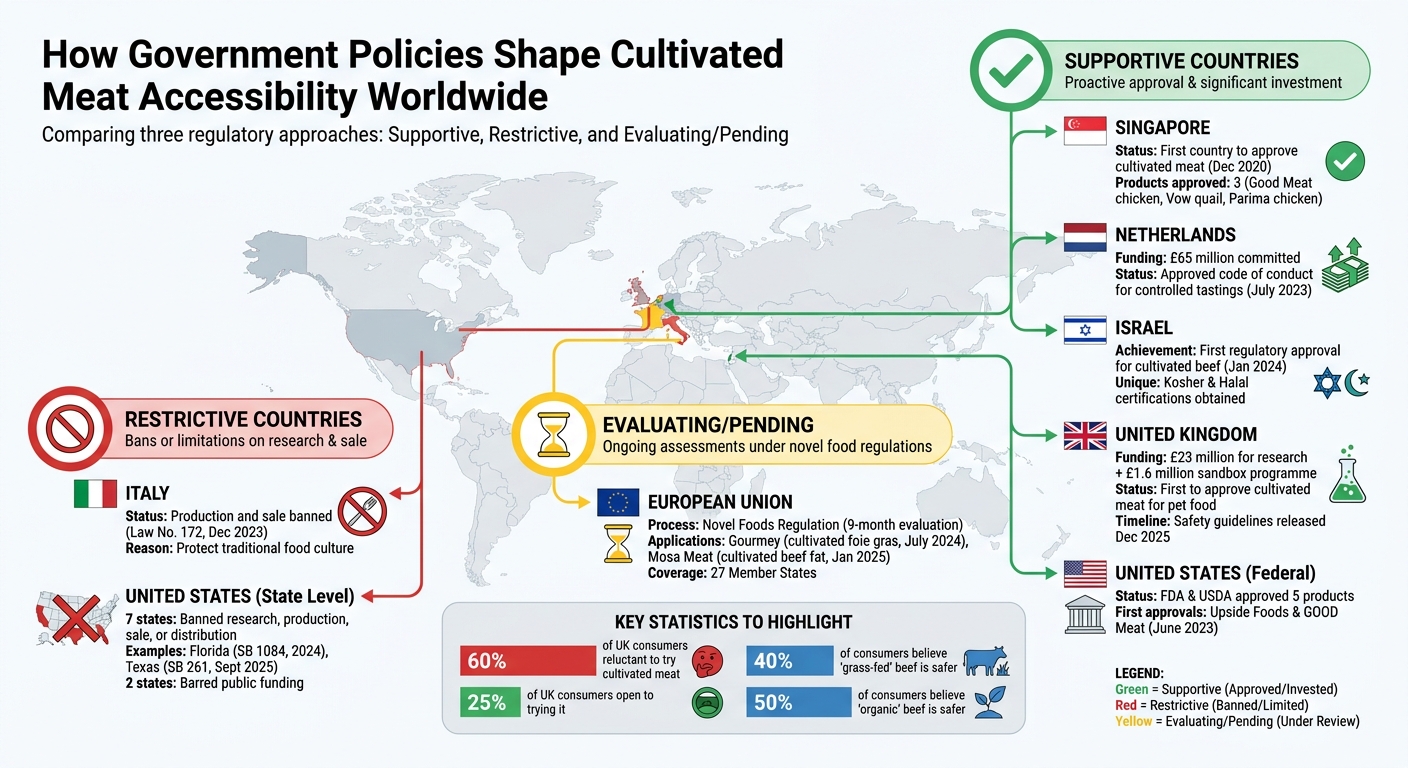
- Singapore: The first to approve cultivated meat for human consumption, with products like Good Meat's chicken and Vow's quail already in the market.
- United States: Federal agencies (FDA and USDA) have approved five products, but state-level bans and labelling rules create hurdles.
- United Kingdom: Approved cultivated meat for pet food and launched a £1.6 million "sandbox programme" to regulate products for human consumption.
- Global Trends: Countries like the Netherlands and Israel are investing heavily in cultivated meat, while others, such as Italy, have imposed bans to protect traditional industries.
Key challenges include high production costs and scaling, and public acceptance. For instance, 60% of UK consumers have expressed reluctance to try cultivated meat. However, regulatory frameworks and government funding are critical in shaping its future. The UK's sandbox programme and other global initiatives aim to address these barriers and bring cultivated meat closer to everyday dining tables.
Global Cultivated Meat Policy Landscape: Regulatory Approaches by Country
Regulatory Frameworks in the United States
Federal Oversight: FDA and USDA Collaboration
In 2019, the Food and Drug Administration (FDA) and the USDA's Food Safety and Inspection Service (FSIS) joined forces to create a regulatory framework for cultivated meat production. Their responsibilities are divided: the FDA handles pre-harvest activities like cell collection, banking, and growth, while the USDA takes over for harvest, processing, packaging, and labelling of livestock and poultry. For cultivated seafood (excluding catfish) and species not classified as livestock, such as elk or deer, the FDA oversees the entire process [4][6].
In June 2023, Upside Foods and GOOD Meat became the first companies to complete this regulatory process, earning inspection grants to sell cultivated chicken [4][6]. Brian P. Sylvester, Partner at Perkins Coie, commented on the swift progress:
"FDA and FSIS have moved at record pace to develop a sound regulatory framework to provide for the production of cultivated meat that is safe and wholesome" [4].
While federal efforts have advanced rapidly, state-level policies present a different set of challenges that could limit market expansion.
State-Level Bans and Restrictions
Even with strong federal oversight, state-level regulations often stand in contrast. By October 2025, seven states had enacted bans on the research, production, sale, or distribution of cultivated meat [5]. For instance, Florida and Texas have implemented such restrictions, with Texas's SB 261 coming into effect in September 2025. Additionally, two other states have barred the use of public funds to support the industry [5]. This fragmented approach means that federal approval doesn't guarantee nationwide availability, as consumers in some states may still lack access to these products. These restrictions also create barriers to interstate commerce, limiting the industry's reach [5].
State-Specific Labelling Requirements
labelling rules add another layer of complexity. States like Oklahoma and Iowa require specific labelling for cultivated meat, while the USDA mandates the term "cell-cultivated." Legal experts anticipate that federal standards will eventually override conflicting state laws [5][7]. Until then, the absence of consistent labelling regulations may confuse consumers and pose challenges for producers operating across state lines.
This mix of federal and state regulations ultimately determines how and where cultivated meat becomes available to consumers across the United States.
sbb-itb-c323ed3
Florida's BAN of Cultivated Meat Explained
Global Policy Developments
Governments across the globe are adopting varied strategies when it comes to regulating cultivated meat. While some nations are pouring resources into its development, others are imposing restrictions. These choices play a critical role in determining where and how quickly consumers can access cultivated meat, shaping market growth in distinct ways.
Government Funding and Support
When governments invest in cultivated meat, it signals a strong commitment to the industry's future. For instance, the Netherlands has committed £65 million to support cultivated meat initiatives, establishing itself as a leader in Europe. This funding has significantly accelerated the industry's growth in the region [8].
Israel has taken a unique path by aligning the technology with religious dietary laws. By obtaining both Kosher and Halal certifications, the country has made cultivated meat accessible to billions of consumers who adhere to these practices. In January 2023, the Ashkenazi Chief Rabbi of Israel declared certain cultivated beef products Kosher, though certification depends on specific production methods [9].
The United Kingdom, meanwhile, has allocated £23 million to cultivated meat research and introduced a sandbox programme to address safety and scalability challenges. In a pioneering move, the UK was the first country to approve cultivated meat specifically for pet food, creating a regulatory framework separate from human food applications [1].
International Regulatory Approvals
Regulatory approaches also differ significantly across nations, reflecting varying levels of readiness to embrace cultivated meat.
Singapore made history in December 2020 by becoming the first country to approve cultivated meat for human consumption [1]. By February 2026, the Singapore Food Agency (SFA) had authorised three products: Good Meat's cultivated chicken, Vow's cultivated quail, and Parima's cultivated chicken [1]. This early regulatory approval has positioned Singapore as a hub for innovation and product testing.
In the European Union, the European Food Safety Authority (EFSA) uses the Novel Foods Regulation to ensure consistent safety assessments across its 27 Member States [8]. French company Gourmey submitted the first-ever request for cultivated foie gras approval in July 2024, followed by Mosa Meat's application for cultivated beef fat in January 2025 [8]. EFSA is required to complete scientific evaluations within nine months of receiving a dossier [8].
However, not all EU countries are on board. Italy introduced Law No. 172 in December 2023, banning the production and sale of food made from cell cultures [8]. Defending the ban, Francesco Lollobrigida, Italy's Minister of Agriculture, stated:
"We wanted to protect our culture and our tradition, including food and wine. If the production of synthetic foods were to be imposed on the markets, there would be greater unemployment, more risks for biodiversity." [9]
These contrasting policies highlight a fragmented global landscape, where access to cultivated meat depends heavily on local regulations and political priorities.
How Policies Affect Consumer Access
Regulations play a key role in determining where cultivated meat is available, how much it costs, and the level of trust consumers place in these products.
Comparing Policy Outcomes
Take the contrast between Florida and the Netherlands as an example. In 2024, Florida passed SB 1084, a law banning the production and sale of cultivated meat to shield the cattle industry from competition [11]. Meanwhile, the Netherlands took a different approach. In July 2023, it approved a code of conduct allowing controlled tastings and allocated £65 million to research and development in alternative proteins [8]. These decisions mean Dutch consumers are likely to access cultivated meat sooner, with local companies thriving under supportive policies. The difference in approach leads to vastly different consumer experiences in these regions.
Labelling standards also play a big part in shaping consumer trust and pricing. In the U.S., labels like "cell-cultivated" aim to provide clarity and build confidence. In June 2023, UPSIDE Foods became the first company in the U.S. to receive USDA Label Approval for its "cell-cultivated chicken", which carries the official USDA inspection seal [10][11]. This move is designed to reassure consumers. Sam Magrath, a Policy Intern at AMPS, explained:
"Ultimately, consumers will have all the information necessary to make informed decisions when considering a purchase of cultivated meat foods" [10].
Clear labelling doesn’t just boost trust - it also influences perceptions of safety and pricing. For instance, research shows that nearly 40% of consumers believe "grass-fed" beef is safer than conventional beef, and 50% feel the same about "organic" beef, even when scientific evidence doesn’t fully back these claims [12]. This "halo effect" suggests that the way cultivated meat is labelled will strongly influence how safe and valuable consumers perceive it to be.
Government funding is another critical factor in making cultivated meat more affordable. Countries like Singapore and Israel have integrated cultivated meat into their national food security strategies, offering generous financial support to speed up commercialisation and lower prices [11]. For example, in January 2024, Israel's Ministry of Health gave Aleph Farms the world’s first regulatory approval for cultivated beef, backed by targeted government investment [11]. In contrast, the U.S. has taken a different stance. A proposed federal bill (H.R. 8757) aims to block federal funding for cultivated meat research and development, which could hinder efforts to make these products more affordable [11].
Cultivated Meat Shop: A Resource for UK Consumers
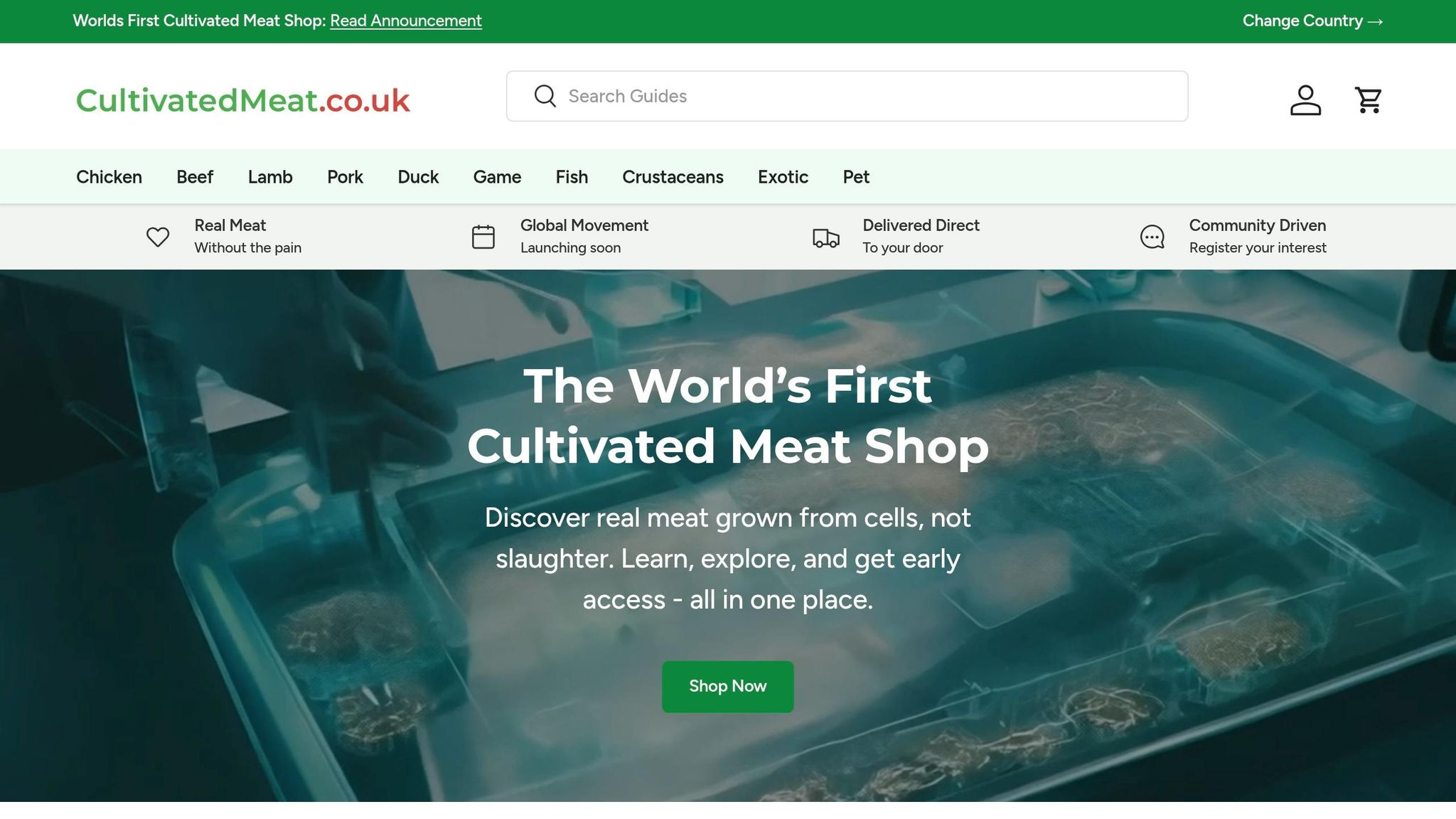
As the journey of Cultivated Meat unfolds in the UK, Cultivated Meat Shop serves as a guide for consumers navigating the changing regulatory landscape. The platform monitors developments like the UK's "sandbox" programme - a £1.6 million initiative from the Food Standards Agency (FSA) and Food Standards Scotland (FSS), launched in March 2025. This two-year programme aims to simplify safety assessments and encourage industry growth [2][3]. By December 2025, the FSA and FSS released the UK's first joint safety guidelines for Cultivated Meat products, marking a significant step forward [2]. These updates provide the foundation for the platform's detailed insights and curated content.
Educational Content and Product Information
Cultivated Meat Shop sheds light on how the UK's regulatory approach, shaped post-Brexit, is expected to offer quicker approvals compared to the EU process [3]. However, the platform clarifies that initial availability will likely be limited to foodservice settings rather than supermarket shelves. Linus Pardoe, Senior UK Policy Manager at Good Food Institute Europe, explains:
"Market authorisation doesn't mean that we're going to be able to buy it in every Tesco in the country from day one. I think what we've seen in other jurisdictions is a very slow, incremental rollout, particularly in foodservice settings" [3].
The platform also addresses concerns raised during the CARMA Citizen Forum, focusing on critical topics such as the need for independent testing, transparency, and ethical oversight. Despite these efforts, a UK consumer survey revealed that only 25% of respondents were open to trying Cultivated Meat, while 60% indicated they would not [2].
Building Consumer Awareness
Through features like waitlist sign-ups and product previews, Cultivated Meat Shop helps prepare UK consumers for the eventual arrival of these products. The platform showcases companies like Ivy Farm Technologies, an Oxford University spin-out, which produces cultivated beef from Angus and Wagyu cattle in just 3–4 weeks - far quicker than the traditional two-year process [3]. Regular updates on the FSA's progress, including its goal to complete safety assessments for at least two Cultivated Meat products by the end of the sandbox programme, ensure consumers remain informed [2]. This steady flow of information promotes transparency and helps UK consumers understand when these products might become part of their dining options.
Conclusion
The path from laboratory innovation to everyday dining tables rests heavily on regulatory frameworks that ensure safety and build public trust. Countries such as the UK, the United States, and Singapore illustrate how well-designed policies - ranging from "sandbox" initiatives to efficient approval processes - can help turn Cultivated Meat from an emerging concept into a regulated food option.
However, the gap between regulatory advancements and consumer trust remains a significant hurdle. Regulation alone cannot secure widespread acceptance. While the UK has made progress with its safety assessment frameworks, many consumers remain hesitant. Dr. Atenchong Talleh Nkobou, Leader of the Citizen Forum at the Royal Agricultural University, points out:
"The future of cultivated meat in the UK will depend not only on scientific innovation, but on how the technology is governed, regulated, and integrated into existing social, cultural, and economic systems" [2].
Cultivated Meat Shop is helping to bridge this gap by making regulatory updates and technological advancements easier for UK consumers to understand. Through tools like waitlist sign-ups, product previews, and updates on the Food Standards Agency's (FSA) progress, the platform simplifies complex topics and provides the clarity needed to counter scepticism.
As more countries approve cultivated meat and infrastructure investments grow, the interplay between transparent policies and well-informed consumers will ultimately decide whether cultivated meat becomes a common choice or stays on the fringes. Cultivated Meat Shop is preparing UK consumers to make informed decisions when these products hit the market.
FAQs
When will Cultivated Meat be available to buy in the UK?
Cultivated meat could hit UK shelves within the next two years. However, this depends on the UK Food Standards Agency completing its planned safety assessment of cultivated foods by 2027. This timeline highlights the increasing focus on introducing this new food category while prioritising safety and meeting regulatory requirements.
Why is Cultivated Meat legal nationally but banned in some US states?
Cultivated meat has received national approval, but its availability might still be limited in certain US states because of differing state regulations. While federal bodies like the FDA and USDA handle safety standards and labelling requirements, individual states retain the power to enforce laws that could restrict its research, production, or sale. These variations highlight how state-level decisions can sometimes diverge from broader national policies.
Will government funding make cultivated meat cheaper for consumers?
Government funding has the potential to bring down the cost of cultivated meat. By investing in research, streamlining regulations, and encouraging industry expansion, these initiatives can cut production costs. This, in turn, could make cultivated meat a more budget-friendly option for consumers in the years ahead.


