

None of these three 3D-printed cultivated meat projects has verified UK consumer sales as of 4 November 2026. My advice: check approval for human consumption and an actual seller listing before treating any announcement as a chance to buy.
I compare two beef projects and one fish collaboration. The main difference? Beef cuts aim for marbling and a steak-like bite; the grouper-style fillet aims to flake. Printed shape alone proves neither.
Quick Comparison
| Project | Species and cut | Structure and thickness | Intended meal | UK availability |
|---|---|---|---|---|
| Aleph Farms | Beef ribeye-style cut | Separate muscle and fat regions; research reported 0.5 cm constructs and 1 cm tissue samples | Pan-fried or grilled steak | Research-stage ribeye; no confirmed UK price or launch |
| Steakholder Foods | Beef steak and layered morsels | Controlled muscle and fat placement; a 104 g steak prototype | Steak dinner or tasting portions | No verified UK approval or consumer sales |
| Steakholder Foods–Umami Meats | Grouper-style fillet | Layers designed to flake; thickness not confirmed | Fish-fillet main course | No verified UK launch, price or sales |
I also separate company tasting claims from independent cooking results , similar to those found in early taste previews, and Aleph Farms’ separate Thin-Cut Steak from its bioprinted ribeye. <u>Approval for one product does not cover another.</u> For you, the checks are simple: ingredients, cooking results, portion size, storage instructions and whether the exact product is approved and on sale.
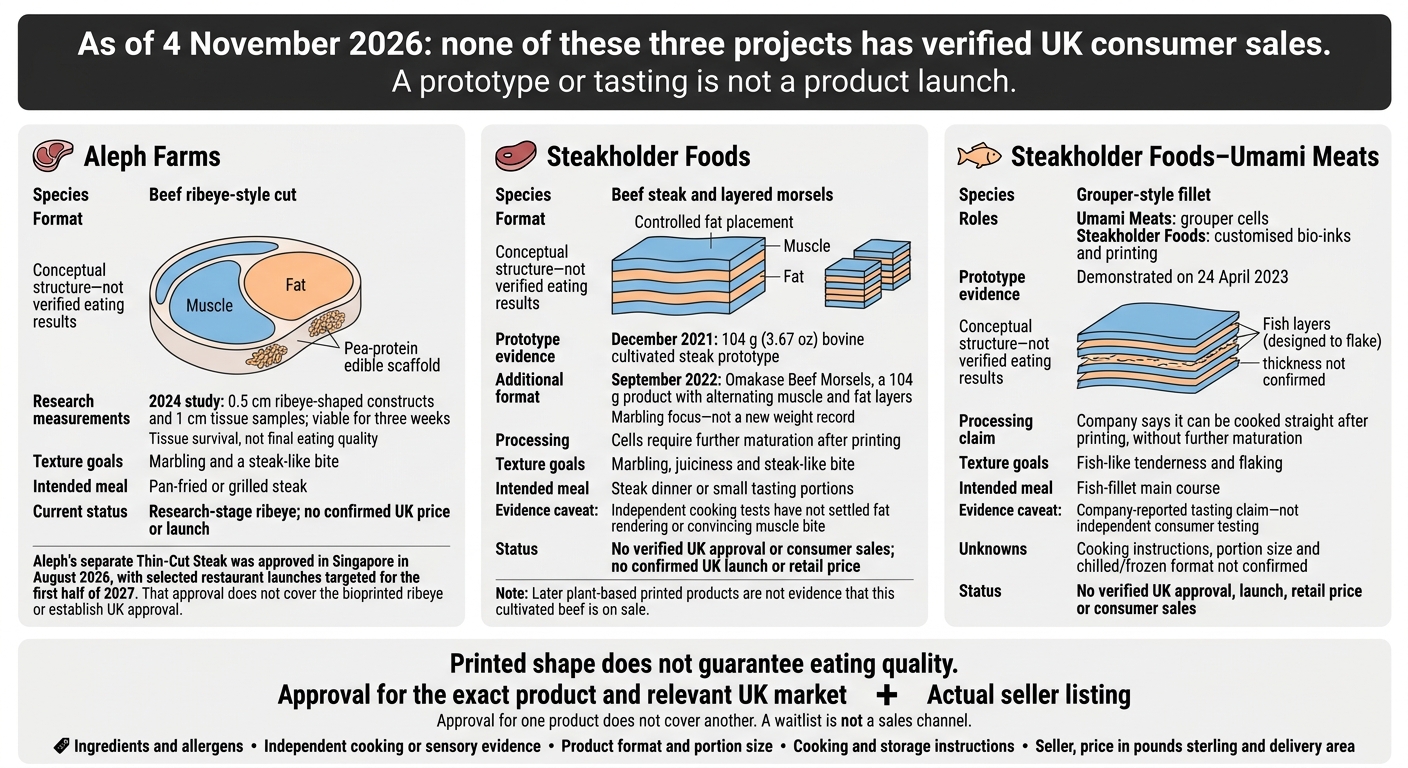
3D-Printed Cultivated Meat: Three Projects Compared
1. Aleph Farms
Cut format and species
Aleph Farms’ research progressed from a small strip-steak proof of concept to a thicker, ribeye-style bovine Cultivated Meat cut, developed with Technion researchers. The goal was a recognisable whole cut with separate muscle and fat regions, rather than mince.[1][8][11]
Structure and texture
The ribeye research used pea protein as an edible scaffold for the cells. Related Technion work tested alginate bio-inks containing pea or soy proteins.[1][10] The vascular-like design aimed to bring nutrients in and carry waste out - not recreate a cow’s full circulatory system.[1]
A 2024 study reported 0.5 cm ribeye-shaped constructs and 1 cm tissue samples that remained viable for three weeks. That shows tissue survival, not final eating quality.[12]
Eating occasion
The likely use is a centre-of-plate steak for pan-frying or grilling.
Development and availability
This bioprinted ribeye is still a research-stage cut, not a product available to buy in the UK. Approvals for separate products do not establish approval for this cut. There is no confirmed UK retail price or launch date, and UK sales would require the relevant authorisation.[7][9]
Next, compare this steak-shaped cut with Steakholder Foods’ different approach to structured Cultivated Meat.
sbb-itb-c323ed3
2. Steakholder Foods
Cut format and species
In December 2021, Steakholder Foods - then called MeaTech 3D - reported a 104 g (3.67 oz) bovine Cultivated Meat steak made from bovine muscle and fat cells.[14] It was a structured whole-cut prototype, not mince.[4]
Structure and texture
The company prints separate muscle and fat bio-inks in digitally controlled positions to shape the steak’s marbling, juiciness and bite.[13][14]
In September 2022, Steakholder Foods introduced Omakase Beef Morsels, a 104 g Cultivated Meat beef product with alternating layers of muscle and fat.[17][18][19] The focus was on marbling, not a new weight record. After printing, the cells still need more time to mature before the steak is finished.[13][14]
Eating occasion
The steak is suited to pan-cooking or grilling, while the morsels suit small tasting portions. Two questions remain: does the cultivated fat render well, and does the muscle deliver a convincing bite? Independent cooking tests have not settled either point.[14][16][19]
Development and availability
There is no confirmed UK launch or retail price. Reports about Steakholder Foods’ later plant-based printed products do not show that its Cultivated Meat steak is on sale. Check the ingredients and approval status, rather than relying on the company name alone.[13][15]
The next section looks at its fish-focused printing work.
Inside the Process of Lab-Grown Beef
3. Steakholder Foods and Umami Meats
Unlike the beef prototypes above, this partnership focuses on a seafood cut designed to flake rather than slice.
Cut format and species
In April 2023, Steakholder Foods and Singapore-based Umami Meats demonstrated a ready-to-cook grouper fillet prototype made using 3D bioprinting. Umami Meats supplied the grouper cells. Steakholder Foods developed the customised bio-inks and printing process that formed the fish-style cut.[2][5][6]
The companies claimed it was the “world’s first” whole Cultivated Meat fish fillet.[21][20]
Structure and texture
The process aimed to give the fillet fish-like layers, tenderness and flaking. According to Steakholder Foods, it could be cooked straight after printing, with no further maturation.[3][22]
Umami Meats’ chief executive, Mihir Pershad, said the tasting showed a product that “flakes, tastes and melts” like fish.[2][5]
This was a company-reported tasting claim, not a finding from independent consumer testing.
Eating occasion
At Steakholder Foods’ facilities in Rehovot, Israel, chef Moran Lidor prepared Singaporean- and Israeli-style dishes. The fillet took the centre of the plate rather than appearing as mince.[5][20] Reports do not confirm cooking instructions, portion sizes or whether it would be sold chilled or frozen. For more on preparation, see our guide to cooking with cultivated meat.
Development and availability
No UK regulatory approval, retail price or sales have been announced.[21][20]
The next comparison looks at shape, thickness and texture, including the difference between a cut that flakes and one that slices.
Comparing Cut Shapes and Texture Goals
The brand profiles above explain what each company is building. Here’s what those design choices aim to deliver in the finished cut.
Beef Steaks and Grouper-Style Fillets
These projects use 3D bioprinting for different goals: steak-like structure in beef and flaking in fish. Printed shape alone does not guarantee a steak- or fillet-like structure, bite or eating quality.
| Brand or collaboration | Shape and structure goal |
|---|---|
| Aleph Farms | A thicker ribeye-style structure with marbling targets. |
| Steakholder Foods | Control over muscle-to-fat placement and geometry. |
| Steakholder Foods and Umami Meats | Grouper cells layered into a fillet designed to flake. |
The scaffolds and bio-inks differ, so printed structures are not the same as conventional meat. The main differences between these cuts now centre on fat, thickness and bite.
Marbling, Thickness and Flaking
Aleph Farms and Steakholder Foods both use fat placement to target marbling. They aim to produce thicker steak-style cuts suited to pan-frying or grilling. These are design targets, not confirmed eating results.
For fish, flaking means separating into moist layers after cooking. That’s the texture sought for a fish-fillet meal, rather than a steak-like bite. Independent testing has not established whether the grouper prototype delivers it. Look for cooking tests or sensory results, not just printed appearance.
The next question is more practical: which format is closer to a meal shoppers might buy?
Comparing Meal Uses and Availability
Steak Dinners and Fish-Fillet Meals
Each project targets a different kind of meal. Here’s how they compare - and what shoppers can expect.
| Brand or collaboration | Intended eating occasion | Current stage | Likely shopper takeaway | UK availability caveat |
|---|---|---|---|---|
| Aleph Farms | Steak-style dinners | Its separate Thin-Cut Steak was approved in Singapore in August 2026, with selected restaurant launches targeted for the first half of 2027.[9][26] | A thin-cut beef steak with a plant-protein base - not the bioprinted ribeye.[25] | A reported UK dossier submission is not approval; UK sales remain unverified.[27] |
| Steakholder Foods beef prototypes | Steak-style dinners or small tasting portions | Printed beef steak and morsel prototypes.[14][17][19] | Thickness and controlled muscle-to-fat placement.[13][14] | No verified UK approval or consumer sales for these projects.[23][27] |
| Steakholder Foods and Umami Meats | Grouper-style fish-fillet main courses | Fillet prototype announced on 24 April 2023.[5][6] | A fillet designed to flake like fish.[23][24] | No verified UK launch date, restaurant sales or supermarket listings.[23] |
For shoppers, familiar cut shapes, ingredients and price will matter more than printed appearance alone.
From Prototypes to UK Sales
Shape does not guarantee eating quality. Nor does a research prototype, demonstration or tasting mean a product is available to buy.
As of 4 November 2026, none of these projects has verified UK consumer sales. Aleph Farms’ Singapore approval does not establish UK approval.[9][23][26][27] However, momentum builds across the globe as regulatory progress continues.
To check UK availability, look for both UK approval and an actual seller listing, rather than relying on a prototype or press announcement.
Conclusion: What to Check Before Buying
Before buying, check the product format, ingredients and cooking evidence rather than relying on the headline label.
Ingredients: Check whether the product contains Cultivated Meat. Look for plant proteins, fats and other ingredients added to give it structure.
Authorisation and location: Next, check whether the product is authorised for human consumption in Great Britain. Pet-food approval does not count as approval for human food.[30][28][29] Confirm who’s selling it, the price in pounds sterling and where they deliver using a product availability checker. A waitlist is not a sales channel.
Texture and format: If the product is authorised, check how it should be cooked. For steak-style cuts and fish fillets, look for instructions that support the claimed cooking result. Check whether you’re buying a raw cut, formed portion, frozen fillet or ready meal. Check the portion size, allergens and storage instructions too.
FAQs
Could 3D-printed Cultivated Meat contain allergens?
Yes. 3D bioprinting often uses edible, plant-based scaffolds, such as soy protein, to give meat its structure. Any allergens in these materials remain in the final product.
Before these products go on sale, manufacturers must follow strict safety procedures, including thorough testing and clear labelling. This tells consumers which ingredients and potential allergens the products contain.
Will Cultivated Meat steaks have the same nutrition as conventional beef?
Cultivated Meat is designed to be biologically identical to conventional meat, with a similar nutritional profile. But producers can fine-tune its composition - for example, by increasing healthy fats and reducing saturated fat.
Edible scaffolds made from plant proteins or grains may also add protein and fibre. This could make Cultivated Meat steaks healthier than conventional beef.
What evidence would show that Cultivated Meat cuts cook like conventional meat?
Evidence comes from tenderness measurements and structural analysis. Warner-Bratzler shear force testing measures how much force it takes to cut through a sample. Some hybrid products have achieved results comparable to conventional meat.
Fibre alignment, tissue density and fat marbling matter too. Recreating these features with 3D bioprinting and edible scaffolding helps Cultivated Meat cuts respond to heat, searing and slicing like conventional steak or fillet.


