

If I want cultivated meat to feel safe, honest and worth buying, serum-free media is one of the first things I look at.
In simple terms, serum-free media means the cells are grown without foetal bovine serum (FBS), a slaughter-linked animal input. That matters to me for four plain reasons:
- Safety: animal-derived serum can bring more contamination risk and more variation between batches
- Animal welfare: serum-free methods remove a clear link to unborn calves
- Consistency: defined ingredients make it easier to get the same result each time
- Price: media can make up 55% to 95% of production costs, so cheaper inputs could help bring shelf prices down
A few figures stand out. UK surveys say 42% to 62% of people would not eat cultivated meat, with safety and trust among the main concerns. One study found that replacing a medium with about 10% FBS cut global warming potential by 80% and water use by 53% per litre of medium. And cost models suggest media changes could push production costs down from about US$22,421 per kg to about US$116 per kg.
If I strip the topic back to the basics, the question is simple: what are the cells fed, and can I trust it? Serum-free media is one of the clearest parts of that answer.
| What I care about | Serum-based media | Serum-free media |
|---|---|---|
| Safety | More risk from animal-linked contaminants | Tighter control with defined inputs |
| Animal welfare | Linked to bovine foetuses at slaughter | No serum from slaughtered animals |
| Product consistency | Batch variation is harder to avoid | Results are easier to keep steady |
| Future price | High-cost input | Better chance of lower costs |
That is the short version: if cultivated meat is going to win over UK shoppers, the feed used to grow the cells matters almost as much as the meat itself.
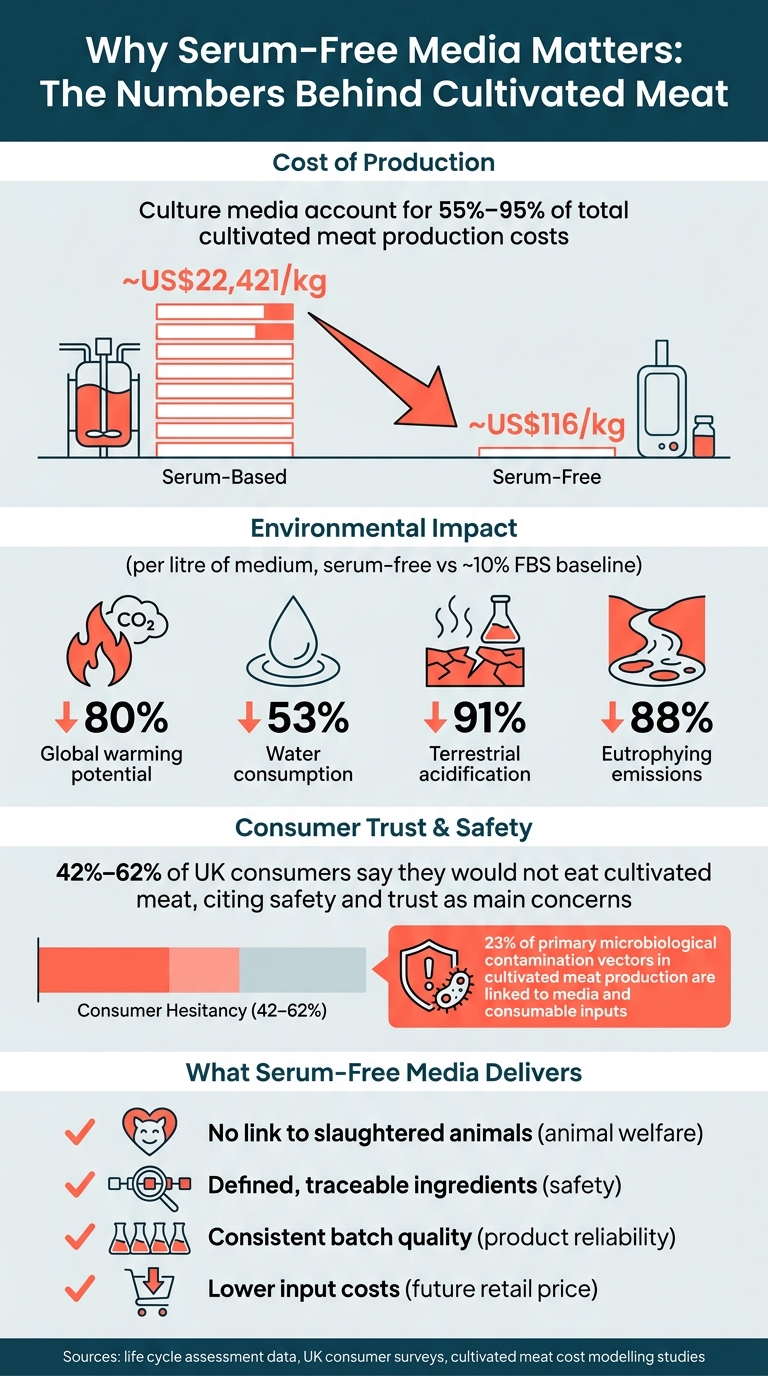
Serum-Free vs Serum-Based Media: Key Stats for Cultivated Meat Consumers
Dr. Peter Stogios: Low-cost growth factors for serum-free media
sbb-itb-c323ed3
The problem with serum: safety, ethics and trust
Foetal bovine serum (FBS) is an animal-derived growth supplement taken from unborn calves, usually after pregnant cows are slaughtered.[8][11] Its make-up can shift depending on the animal’s age, diet and origin. Scientists describe it as an undefined input that varies from batch to batch.[9][10] In food production, that kind of variation makes transparency harder.
Why serum raises animal welfare concerns
The appeal of Cultivated Meat vs. Traditional Meat is simple: real meat, with far fewer animals harmed. That’s why many people react strongly when they find out that standard cell culture has long relied on serum taken from foetuses at slaughter.[4][7] It clashes with what many consumers think they are signing up for.
For people who expect Cultivated Meat to cut harm, serum-based production can feel like a clear contradiction.
There’s also a practical issue here. FBS is difficult to standardise, which adds another layer of uncertainty.
Why consumers may question safety and transparency
Because FBS is an undefined biological mixture, it can carry contaminants such as viruses, bacteria, fungi, prions and endotoxins.[4][5][3] And when an ingredient comes from an animal source with a variable make-up, it becomes harder to trace, explain and trust.[10][2]
That same animal-derived input does two things at once: it sparks animal welfare concerns and makes the production process less controlled. So for consumers, this isn’t just about ethics. It’s also about whether the ingredient list is clear, controlled and traceable.
These are the exact weak points that serum-free media is meant to fix.
| Aspect | Serum-based media | Serum-free media |
|---|---|---|
| Source | Animal-derived, from bovine foetuses at slaughter [8][11] | Non-animal or defined components designed to replace serum [1][2] |
| Ethical concerns / Consumer trust | Relies on slaughter; inconsistent with a lower-harm promise; opaque ingredient source undermines confidence [10][2] | Better aligned with animal welfare expectations; supports clearer labelling and shopper confidence [1][2] |
| Contamination risk | Can carry viruses, bacteria, fungi, prions and endotoxins [4][5][3][10] | Lower risk from animal-derived contaminants when properly designed [1][2] |
| Consistency | Variable and less well defined between batches [9][10][2] | More predictable, with a clearer, controlled formulation [1][2] |
That is why a more defined input matters before cultivated meat reaches shoppers.
How serum-free media improves safety and product quality
Serum-free media swaps animal serum for defined nutrients and growth factors, which means producers know exactly what goes into the process. Nothing is left vague or guessed at. That level of control matters for product quality and safety compared to traditional meat.
Clearer ingredients and lower contamination risk
When every part of the growth medium is documented, testing, checking and tracing become much simpler. Producers can test and sterilise each ingredient on its own, instead of depending on an animal-based mixture with more variability. That has a direct safety upside: a survey of Cultivated Meat producers found that 23% of primary microbiological contamination vectors were linked to media and consumable inputs.[3] If the medium is more tightly controlled, that risk is easier to cut down.
Defined ingredients also sit more neatly within UK food safety controls. Each input has a known profile, so if a hazard appears, producers can link it to a specific ingredient and deal with it directly.
| Consumer concern | How serum-free media helps |
|---|---|
| Contamination | Uses defined, sterilised ingredients with robust testing, lowering the risk from microbes, viruses and endotoxins |
| Uneven quality | Standardised recipes produce more consistent cell growth, texture and flavour across batches |
What this means for taste, texture and consumer confidence
A steadier growth environment usually leads to a steadier result on the plate. When cells receive the same nutrient mix each time, they are more likely to develop a more even texture, which shapes tenderness and bite. Defined fat inputs also help with predictable fat distribution, which affects flavour release and juiciness.
For UK shoppers, this goes beyond taste. People want to know that the product they buy today will match the one they buy next month. Serum-free processes, with documented inputs and traceable production steps, make that kind of reliability much easier to deliver. That consistency can strengthen consumer confidence. It may also help reduce production costs later.
How serum-free media supports animal welfare, sustainability and lower prices
Beyond safety and consistency, serum-free media also affects whether Cultivated Meat can live up to its bigger promise.
A better fit for animal welfare and climate-minded shoppers
Cultivated Meat is often sold on the idea that it cuts animal harm. But if the cells are grown in foetal bovine serum, that message starts to wobble. Serum-free media remove that tie to slaughter-derived inputs, so the process lines up more closely with the reasons many people are interested in the first place.
The switch also matters for climate impact. Serum-based media carry the footprint of cattle farming with them: land use, water use, feed demand, and greenhouse gas emissions. One life cycle assessment found that replacing a baseline medium with around 10% FBS with a serum-free option cut global warming potential by 80%, water consumption by 53%, terrestrial acidification by 91%, and eutrophying emissions by 88% per litre of medium.[6] For shoppers who see Cultivated Meat as a lower-impact option, that’s a big deal. Serum-free media don’t fix everything, but they do move things in the right direction.
| Impact area | Serum-based media | Serum-free media |
|---|---|---|
| Land use | Indirectly tied to land-intensive livestock farming | Lower reliance on livestock-linked inputs; plant-based and bioprocess ingredients |
| Water use | Carries livestock system water footprint | Up to 53% lower per litre of medium [6] |
| Emissions | Upstream cattle farming adds methane and CO₂ | Up to 80% lower global warming potential per litre [6] |
Why lower input costs matter for future retail prices
Cost matters for a simple reason: it will help decide whether Cultivated Meat can sit on supermarket shelves at a price people will pay. Culture media are the biggest cost in production, making up about 55–95% of total production expenses.[12][2] Serum-based formulations are costly and hard to scale, and in some processes FBS alone makes up 50% to 80% of media costs.[12][13]
Serum-free formulations start to change that picture. Modelling suggests that swapping expensive growth factors for other ingredients could cut projected production costs from about US$22,421 per kilogram to about US$116 per kilogram.[13] No one can say yet what the final UK retail price will be. But the direction is plain enough. If input costs fall that sharply, it will shape what UK shoppers one day see on shelf.
What serum-free media means for UK consumers right now
Cultivated Meat is not yet approved for sale in Great Britain. Right now, that means one thing matters most for consumers: transparency.
What to look for as products approach the UK market
Before these products appear on shelves, the main issue is simple: how were they made? Once products begin moving towards the UK market, shoppers should pay attention to three things:
- clear disclosure of the growth medium
- safety checks
- the production method
If a company can't explain those points in plain English, that's a good reason to hold off.
After that, look at the ingredients list, the product format, and any news on UK availability. Those are the practical signs that help you decide whether a new food product is worth trying.
Existing regulatory approvals for Cultivated Meat have been serum-free.[15] That already tells us something about the current regulatory picture.
For plain-English updates on future UK availability, Cultivated Meat Shop is a useful starting point - a consumer education and discovery platform where you can explore product previews and join the waitlist.
Conclusion: why serum-free media matters for consumers
Serum-free media is a direct response to what most consumers reasonably expect from a new food product: clear ingredients, ethical production, consistent quality, and a realistic path to lower prices.[1][2][14] For UK shoppers, it's one of the clearest signs that Cultivated Meat is moving towards a food system people can trust.
FAQs
What is serum-free media?
Serum-free media is a carefully formulated nutrient solution used to grow cells for Cultivated Meat without animal-derived ingredients like Fetal Bovine Serum.
Using a chemically defined mix instead makes production safer, more consistent, and easier to control. It also helps address ethical concerns, support product quality, and meet food safety requirements for regulatory approval.
Why is FBS controversial?
Fetal Bovine Serum (FBS) is controversial mainly because of ethics. It is taken from bovine foetuses and is tied to the slaughter of pregnant cows.
There are also safety and production issues. Because it comes from animals, it may carry contaminants such as viruses, mycoplasma and prions. On top of that, batch-to-batch variation can make results less consistent and create problems for regulatory approval and scaling Cultivated Meat.
Will serum-free media make Cultivated Meat cheaper?
Yes. Serum-free media plays a big part in making Cultivated Meat more affordable, because growth media still accounts for over 95% of production costs.
The main reason is simple: current media can be very expensive. When producers swap out costly animal-derived and pharmaceutical-grade inputs for lower-cost food-grade ingredients, costs start to drop. From there, teams can fine-tune the formulation to bring spending down even more.
That shift is already making a difference. Media costs have fallen to as low as £0.50 per litre, which helps push Cultivated Meat closer to price parity with conventional meat by the early 2030s.


