

Every product impacts the planet - from raw materials to disposal. Life Cycle Assessments (LCAs) measure these impacts, offering a detailed view of a product's footprint throughout its life span. For emerging industries like cultivated meat, LCAs are key to understanding whether they can reduce global emissions compared to conventional meat.
What makes LCAs effective today? Digital tools like SimaPro and OpenLCA streamline the process, using databases like Ecoinvent and Agribalyse to model complex systems. These tools allow researchers to estimate future production impacts, identify problem areas, and test improvements without costly physical trials.
For cultivated meat, LCAs highlight two major challenges: energy use in bioreactors and sourcing protein for growth media. Recent studies, such as Bene Meat Technologies' April 2026 LCA, show how optimising inputs and energy sources can lower carbon footprints and energy demands.
Why does this matter? Reliable LCAs depend on transparent data, adherence to ISO standards, and clear assumptions. By combining digital tools with real-world data, researchers can create more accurate assessments, helping producers refine processes and consumers make informed choices.
IE Day 2024 - Next-Gen LCA Tools: Unveiling the Latest Developments and Solutions
To see how these metrics translate into real-world data, you can use a cultivated meat sustainability calculator to compare environmental impacts.
sbb-itb-c323ed3
What Is a Digital Life Cycle Assessment?
Digital tools have transformed the traditional Life Cycle Assessment (LCA) process, making it faster and more precise. A Digital Life Cycle Assessment leverages modelling software and environmental databases to evaluate a product's environmental impact from creation to disposal. Instead of manually inputting raw data, researchers rely on software platforms that automate intricate calculations. These platforms, such as SimaPro and OpenLCA, work alongside standardised environmental databases like Ecoinvent, Agri-footprint, and Agribalyse. The software handles the calculations, while the databases provide consistent background data for common inputs, including electricity, water, and transportation.
When it comes to Cultivated Meat, digital LCAs are especially critical. The production process involves managing a vast array of ingredients - amino acids, growth factors, vitamins, salts - and meeting the specific energy requirements of different bioreactor designs. Handling such complexities manually is nearly impossible. Digital tools systematically organise these intricate inventories, and when data for new ingredients is unavailable, researchers use proxy values from similar processes to fill the gaps [2][3]. This approach helps predict the environmental impact of future large-scale production, even when current data is incomplete.
One standout feature of digital LCAs is their ability to perform prospective modelling. Since Cultivated Meat production is still in its early stages, researchers can use process simulation software to estimate the environmental footprint of a future commercial-scale facility [1].
"These engineering models of commercial scale production provide most of the flow data needed for an LCA, which would result in a simulated commercial scale LCA." - Guidelines for Environmental Life Cycle Assessment of Cultivated Meat [1]
A practical example of this is SCiFi Foods' work. In December 2022, they used digital LCA tools (OpenLCA with Agribalyse V3.0.1 and Ecoinvent V3.8) to analyse their blended Cultivated Meat burger. The results were striking: it required 39% less energy and 90% less land compared to a traditional beef patty [3].
Next, we’ll look at how these digital tools help refine and improve Cultivated Meat production processes.
The LCA Process Step by Step
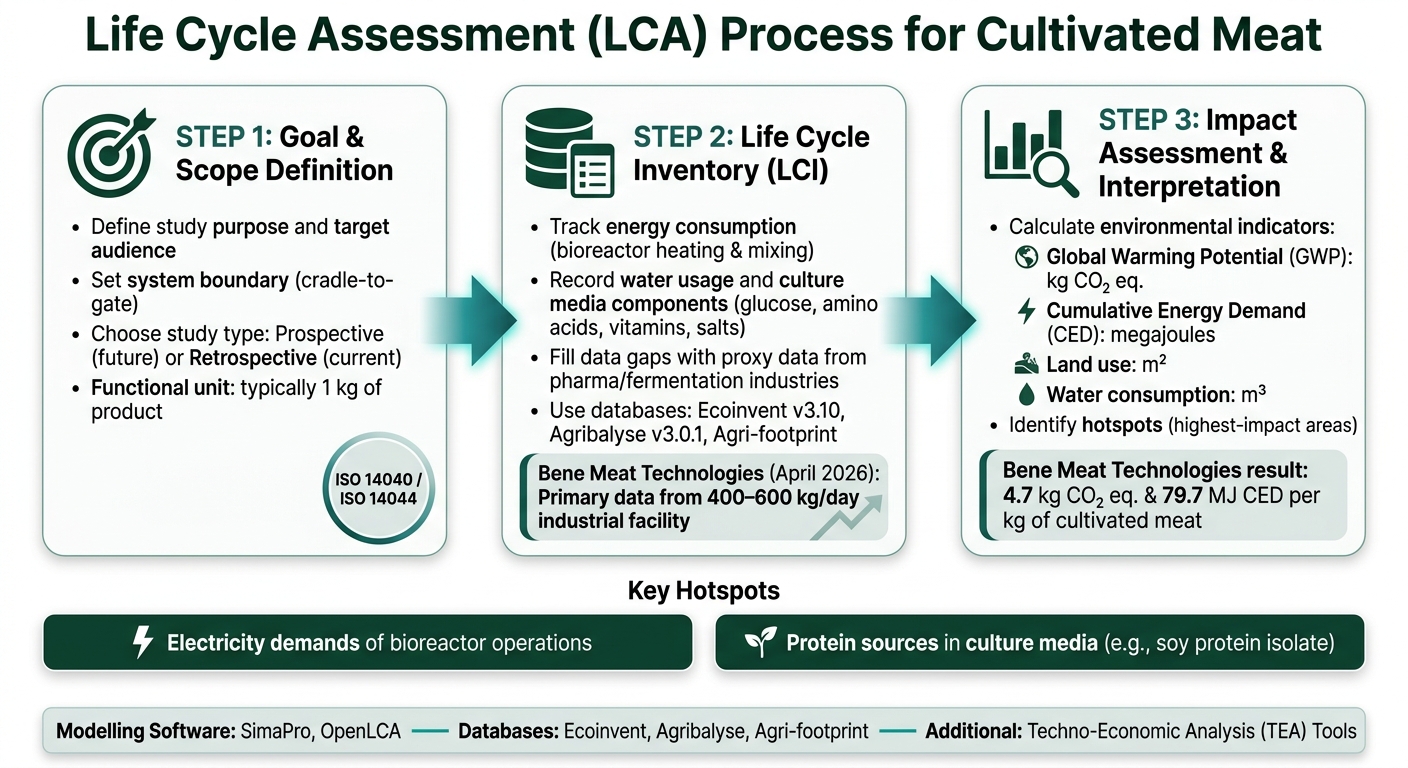
LCA Process for Cultivated Meat: Step-by-Step Digital Workflow
The Life Cycle Assessment (LCA) process for Cultivated Meat follows the guidelines of ISO 14040 and ISO 14044, ensuring consistency and reliability. This structured approach is crucial, especially for a developing technology like Cultivated Meat, where inconsistent methodologies could make comparisons between studies impossible. By adhering to these standards, digital tools can effectively refine and improve LCA outcomes for Cultivated Meat production.
"Comparability across studies and the ability to replicate results from individual studies is paramount to advance the field." - Blackstone et al., Guidelines for Environmental Life Cycle Assessment of Cultivated Meat [1]
Step 1: Goal and Scope Definition
The first step involves defining the study's purpose and setting its boundaries. This includes identifying the target audience and deciding on the system boundary - essentially, what aspects of the production process are included or excluded in the assessment.
For Cultivated Meat, most LCAs adopt a cradle-to-gate approach. This means the analysis ends when the product leaves the production facility, without considering downstream activities like retail storage or home preparation. These stages are often similar for both conventional and Cultivated Meat, so excluding them ensures a fair comparison [1][3]. Researchers also need to clarify whether the study is prospective (predicting future commercial scenarios) or retrospective (using current data). This distinction is critical, as lab-scale processes differ significantly from industrial production.
Another key element is defining the functional unit, which serves as the baseline for comparisons. For Cultivated Meat, this is typically 1 kg of product. However, to ensure comparisons with conventional meat are nutritionally relevant, experts suggest also reporting metrics like dry matter and protein content [1][2].
Step 2: Life Cycle Inventory
With the scope established, researchers then gather a comprehensive inventory of inputs and outputs throughout the production process. For Cultivated Meat, this includes tracking energy consumption (e.g., for bioreactor heating and mixing), water usage, and all culture media components, such as glucose, amino acids, vitamins, and salts. Digital tools simplify this process, helping researchers manage the vast amount of data involved.
Data gaps are a common challenge here. Information on certain elements, like growth factors or scaffold materials, is often unavailable or commercially sensitive. To fill these gaps, researchers rely on proxy data from related industries, such as pharmaceuticals or fermentation [1][4]. A significant step forward came in April 2026, when Bene Meat Technologies provided primary data from their industrial-scale facility, which produces 400–600 kg of Cultivated Meat daily. This contribution offered some of the most detailed and reliable inventory data in the field to date [2].
Step 3: Impact Assessment and Interpretation
The final step involves translating inventory data into environmental benefits. These include metrics like Global Warming Potential (GWP) in kg CO₂ equivalent, Cumulative Energy Demand (CED) in megajoules, land use in square metres, and water consumption in cubic metres. This phase also identifies key "hotspots" - areas of the process with the most significant environmental impact.
For instance, the 2026 Bene Meat Technologies study reported 4.7 kg CO₂ eq. and 79.7 MJ of CED per kg of Cultivated Meat at an industrial scale [2]. Across most LCAs for Cultivated Meat, two consistent hotspots emerge: the electricity demands of bioreactor operations and the protein sources in culture media, such as soy protein isolate [2][3]. By pinpointing these areas, LCAs provide actionable insights, helping producers focus their efforts on reducing environmental impacts where it matters most.
Digital Tools Used in Life Cycle Assessments
Understanding the tools researchers use helps explain how Life Cycle Assessment (LCA) results are generated for Cultivated Meat production.
Modelling Software
Modelling software is essential for consolidating LCA data. It allows researchers to create a digital representation of the production process, detailing every input and output while calculating environmental impacts. Two popular tools in Cultivated Meat research are SimaPro and OpenLCA.
SimaPro, a well-established tool in the food and beverage sector, is valued for its precision and access to integrated databases. For instance, SimaPro version 9.6.0.1 was used by Bene Meat Technologies in April 2026 for the first extensive LCA based on primary data from an industrial-scale Cultivated Meat facility. On the other hand, OpenLCA is an open-source platform often preferred in academic contexts due to its flexibility. Both tools have been utilised in studies showing reduced environmental impacts compared to traditional meat production.
These tools also enable scenario analysis, which means researchers can model how specific changes, like adopting renewable energy, influence the overall environmental footprint. This feature is particularly useful as Cultivated Meat production technologies continue to evolve.
Life Cycle Databases
Modelling software relies on data, which comes from life cycle databases. These databases provide standardised environmental data for common inputs such as electricity, transport, chemicals, and agricultural ingredients.
Three databases frequently appear in Cultivated Meat LCA studies:
- Ecoinvent (version 3.10), known for its broad industrial and energy data, was used in both the Bene Meat Technologies and SCiFi Foods studies [2][3].
- Agribalyse (version 3.0.1), which focuses on agricultural and food products, is especially useful for analysing culture media components like glucose and amino acids. It featured in the SCiFi Foods study.
- Agri-footprint, another database specialising in agriculture, was used alongside Ecoinvent in the Bene Meat Technologies study [2].
In addition to these databases, direct data collection from production sites ensures more accurate results.
Data Collection Platforms
While databases provide background information, accurate LCAs also depend on foreground data - real-world measurements gathered directly from production facilities. This includes figures like energy usage in bioreactors, water consumption, and precise inputs and outputs of culture media. Incorporating such facility-specific data enhances the reliability of LCAs compared to those based solely on theoretical or lab-scale data.
Foreground data, when combined with Techno-Economic Analysis (TEA) tools, helps bridge the gap between pilot-scale data and commercial-scale predictions. This enables researchers to evaluate how costs and environmental impacts change as production facilities scale up [1].
"Sustainability decisions in food and beverage rely on credible data. Supply chains are complex... Organisations across the value chain need tools that can capture this complexity while supporting robust sustainability analysis and reporting." - SimaPro [5]
By combining these digital tools, researchers can construct a detailed and reliable picture of Cultivated Meat's environmental performance.
| Tool Category | Common Examples | Role in Cultivated Meat LCA |
|---|---|---|
| Modelling Software | SimaPro, OpenLCA | Builds system models and calculates environmental impacts |
| Life Cycle Databases | Ecoinvent, Agribalyse, Agri-footprint | Provides background data for energy, ingredients, and chemicals |
| Simulation & TEA Tools | Techno-Economic Analysis software | Simulates commercial production scenarios using pilot data |
How Digital Tools Are Applied to Cultivated Meat
Finding High-Impact Areas in Production
Digital tools are revolutionising the way environmental impacts are assessed in Cultivated Meat production. These tools make it possible to pinpoint hotspots - the stages in production that have the greatest environmental impact. Life Cycle Assessment (LCA) software is especially useful here, providing precise data to identify where improvements are most needed.
Take the example of SCiFi Foods. In December 2022, they collaborated with researchers from The Ohio State University, including Dr Bhavik R. Bakshi, to evaluate a blended Cultivated Meat burger using OpenLCA software. The findings were eye-opening: cell cultivation alone was responsible for 63% of greenhouse gas emissions and 69% of total energy demand. This was largely due to the electricity required to power bioreactors [3]. On the other hand, the plant-based components of the burger, such as Soy Protein Isolate (SPI) and coconut oil, were the main contributors to land and water use. Specifically, SPI accounted for a staggering 99% of the land use impact within the ingredient category [3].
By breaking down each production step - be it mixing growth media, running bioreactors, or processing the final product - digital tools provide a clear picture of how each stage affects different environmental metrics. This level of detail allows producers to explore practical alternatives for reducing their overall footprint.
Testing Scenarios to Improve Outcomes
Once high-impact areas are identified, digital tools go a step further by enabling scenario testing. This means producers can simulate changes and assess their potential benefits without needing to make costly physical adjustments first.
For instance, Bene Meat Technologies used SimaPro in April 2026 to model various scenarios for their industrial-scale facility, which produces 400–600 kg of meat daily. They tested different sources for Soy Protein Isolate - comparing suppliers from China, the Netherlands, and the US - and evaluated the Czech electricity grid for 2024 versus projected conditions in 2030. The results were promising: by optimising inputs and energy sources, they managed to reduce the carbon footprint from 4.7 kg CO₂ eq. to 3.3 kg CO₂ eq. per kilogram of meat. Additionally, the Cumulative Energy Demand dropped to 61.5 MJ per kilogram [2].
"The findings demonstrate that cultivated meat, when produced at scale, can offer a comparable or lower environmental footprint than conventional chicken, particularly when key inputs and energy sources are optimised." - Bene Meat Technologies Case Study [2]
This ability to model hundreds of scenarios digitally is invaluable for an industry where production methods are still evolving. Producers can experiment with different raw materials, energy grids, and process designs to determine the most sustainable options - all without committing resources prematurely. This iterative process of identifying issues and testing solutions highlights just how central digital tools are to improving the environmental performance of Cultivated Meat production.
How to Judge the Reliability of LCA Results
Why Assumptions and Data Transparency Matter
The conclusions of an LCA (Life Cycle Assessment) report often rest on key assumptions, which can significantly influence the results, especially in the case of Cultivated Meat. For instance, using pharmaceutical-grade ingredients - requiring intensive purification - can lead to environmental footprints far greater than when food-grade ingredients are assumed. Researchers at the University of California, Davis, highlighted this in their findings:
"The environmental impact of near-term ACBM production is likely to be orders of magnitude higher than median beef production if a highly refined growth medium is utilised." - Derrick Risner et al., University of California, Davis [6]
This underscores the importance of data transparency. When studies openly share their assumptions - like the energy grid used, the sourcing of ingredients, including how nutrients reach cells, or whether the data is based on actual facilities or theoretical models - it allows readers to gauge how relevant the findings are to real-world production. Without this clarity, comparing studies becomes much less reliable.
Blackstone et al. emphasised this point in their guidelines for Cultivated Meat LCA methodology:
"Comparability across studies and the ability to replicate results from individual studies is paramount to advance the field." [1]
A Checklist for Assessing LCA Reports
When evaluating sustainability claims about Cultivated Meat, a few simple checks can help you determine how reliable the claims are.
| What to Check | What to Look For |
|---|---|
| Standards compliance | Does the study adhere to ISO 14040/14044 or Product Environmental Footprint (PEF) guidelines? [1][2] |
| Independent review | Was it critically reviewed by independent experts, rather than just an internal team? [1] |
| Data source | Is the data from a real pilot or industrial facility, or based on theoretical lab-scale models? [1][2] |
| Energy mix | Does it reflect a current electricity grid, or assume a future decarbonised scenario for 2030/2050? [2] |
| Sensitivity analysis | Does it explore how results change with key inputs, like energy sources or ingredient origins? [1][3] |
| System boundary | Is it clear whether the study considers cradle-to-gate or cradle-to-grave, and does it match the comparison product? [1] |
Applying these criteria makes it easier to compare LCA results across different studies. Reports that meet these standards are more reliable than those presenting only headline figures. For instance, the SCiFi Foods LCA from December 2022 included a Monte Carlo simulation to address data uncertainty - a step that demonstrates methodological thoroughness [3]. Similarly, Bene Meat Technologies' April 2026 study used primary data from an actual facility, providing more grounded findings compared to studies relying on theoretical models [2].
The scale of the data used also plays a crucial role. Early-stage studies based on laboratory experiments (BioMRL 1–3) are valuable for research but shouldn't be used to make bold public claims about commercial performance. By contrast, studies that draw on industrial or pilot-scale data (BioMRL 7–10) are much better suited for evaluating commercial viability. These evaluation criteria help build confidence in LCA findings and provide a clearer foundation for understanding their implications in decision-making.
Conclusion: Why Digital Tools Matter for Cultivated Meat LCAs
Digital tools have transformed how Life Cycle Assessments (LCAs) are conducted for cultivated meat. Tools like SimaPro and OpenLCA, paired with standardised databases such as Ecoinvent and Agribalyse, enable researchers to move beyond rough estimates. They can now simulate actual production scenarios, explore the impact of various energy sources or ingredients, and even use Monte Carlo simulations to evaluate uncertainty.
These advancements lead to tangible production improvements. For instance, Bene Meat Technologies' April 2026 LCA, which used primary data from an industrial-scale facility, demonstrated how digital modelling can uncover optimisation opportunities that traditional methods, like lab-scale spreadsheets, simply can't reveal.
As Blackstone et al. highlight:
"Responsibly and consistently investigating the environmental impacts of cultivated meat is essential to provide reliable performance benchmarks and realistic comparisons with animal-based production systems." [1]
This statement emphasises the importance of rigorous digital methods and transparent data in producing credible LCA reports. The reliability of an LCA depends heavily on whether it uses real facility data, adheres to ISO 14040/14044 or PEF guidelines, and is clear about its assumptions. A practical checklist can help assess these factors. The more a study relies on robust digital tools and primary data, the more trustworthy its conclusions.
For those considering sustainable choices at Cultivated Meat Shop, understanding these digital advancements is key to making informed decisions. Digital tools not only enhance LCA precision but also give consumers the confidence to evaluate sustainability claims critically.
FAQs
What’s the difference between a digital LCA and a traditional LCA?
A Life Cycle Assessment (LCA) measures the environmental impact of a product throughout its entire life cycle - from production to disposal.
There are two main approaches to conducting an LCA:
- Traditional LCAs: These rely on manual analysis performed by experts, making the process detailed but time-consuming.
- Digital LCAs: These use specialised software to automate much of the process. Digital tools can either assist professionals or allow users to generate estimates independently, thanks to built-in datasets.
Despite differences in methods, all LCAs follow the same fundamental stages. This consistency ensures a clear and thorough understanding of the sustainability of products like Cultivated Meat.
Which assumptions most affect cultivated meat LCA results?
Life Cycle Assessments (LCAs) for cultivated meat hinge on a few key assumptions. One major factor is the energy source, as the production process demands significant energy. Another critical element is the growth medium ingredients, including how they’re purified. The outcomes of LCAs are also shaped by various other aspects, such as whether production occurs in a laboratory or on an industrial scale, the technology being used, geographic location, the time period considered, and the comparison products and system boundaries selected for the analysis.
How can I tell if an LCA study is trustworthy?
To evaluate the reliability of a Life Cycle Assessment (LCA) for cultivated meat, ensure it aligns with established standards such as ISO 14040/14044 or PEF guidelines. Trustworthy LCAs rely on primary data from industrial-scale operations and provide clear details about their objectives, system boundaries, and functional units.
A transparent LCA will also tackle data gaps, clarify any assumptions, and incorporate scenario analysis to factor in variations, such as differences in energy use or supply chain inputs. These elements are key to ensuring the assessment reflects realistic and accurate outcomes.


