

Growth factors are the most expensive part of producing cultivated meat, accounting for up to 99% of cell culture media costs. To make cultivated meat affordable (targeting £8/kg), these costs must drop by 99%. Currently, key growth factors like FGF2 cost around £147 per milligram (£147,000 per gram), making large-scale production economically unfeasible.
Key points:
- Growth factors can contribute up to 90% of production costs.
- FGF2 prices fell from £1,500/mg (2018) to £147/mg (2022) but remain far from the £100,000/kg target.
- Cultivated meat production costs still exceed £320/kg compared to conventional meat prices of around £6/kg.
- Research efforts focus on cost reduction through self-producing cells, scaling production, and optimising growth media.
Without drastic cost reductions, cultivated meat cannot compete with conventional meat prices.
What Growth Factors Cost Today
Price Ranges for Key Growth Factors
Back in 2018, FGF2 came with a hefty price tag of £1,500 per milligram (£1.5 million per gram)[2]. Fast forward to September 2022, and suppliers like ORF Genetics were offering it for £147 per milligram, or £147,000 per gram[2]. While this drop reflects some market adjustments, the pricing still poses a major hurdle for scaling up meat production.
Meanwhile, Essential 8 serum-free medium, a key ingredient, costs approximately £305 per litre[2][5]. Within this formulation, growth factors dominate the expense, accounting for 99% of the cost. Specifically, FGF2 and TGF-β contribute 96% to the total, while other components like insulin, albumin, and transferrin add between £32 and £81 per litre when sourced from commercial suppliers[2].
"Growth factors can cost thousands of dollars a gramme, which is fine if you're using them to culture cells in a laboratory, but presents something of a problem if you're using them to produce tonnes of meat." - Elaine Watson[4]
Adding to the challenge is the limited global production capacity for certain proteins like transferrin, which is capped at just 0.2 to 0.3 metric tonnes annually[1]. These proteins are primarily produced for biopharmaceutical applications, where small-scale, high-purity production justifies their steep prices.
These figures paint a clear picture of the financial challenges that need to be tackled.
Why High Growth Factor Costs Matter
At these prices, the science of producing cultivated meat on a commercial scale is simply not feasible. Using current media formulations, the cost to produce a single kilogram of cultivated meat exceeds £320[5]. Compare that to the roughly £6 it costs to produce a kilogram of conventional ground beef[5], and the disparity becomes alarmingly clear. A single burger could cost over £320[5], turning it into an unaffordable luxury item.
To compete with traditional meat, cultivated meat must hit a retail price of £8 per kilogram. For that to happen, growth factors and recombinant proteins need to contribute no more than £0.80 per kilogram - just 10% of total production costs[1]. Achieving this goal would require slashing current biopharmaceutical production costs by 99%[1]. Without such drastic reductions, the dream of affordable cultivated meat for the masses remains out of reach.
"It's not the only limiting factor [to the commercial viability of cell-cultured meat] but it's definitely a bottleneck that needs to be addressed." - Jane Lam, VP global business development & alliances, CellRx[4]
sbb-itb-c323ed3
Trends in cultivated meat scale-up and bioprocessing
Target Costs for Affordable Cultivated Meat
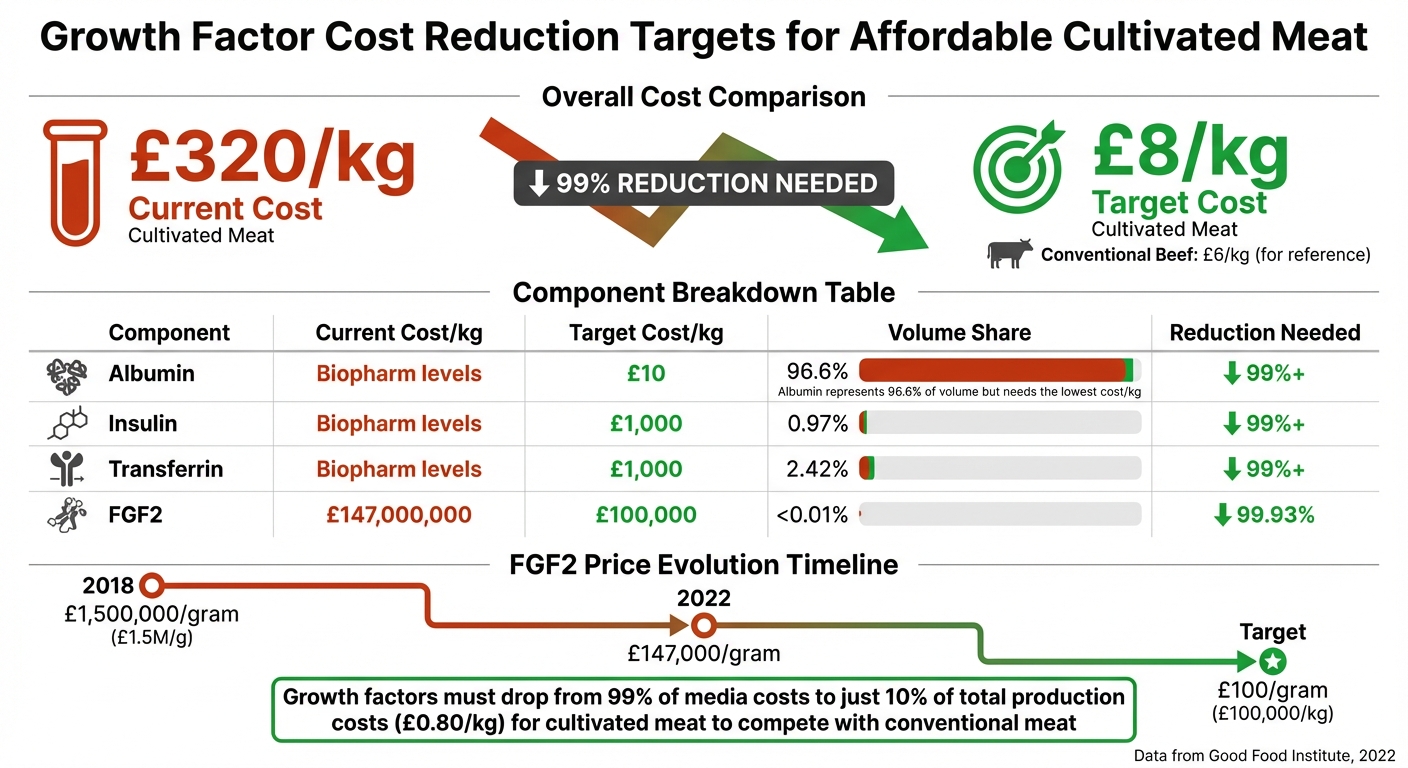
Cultivated Meat Growth Factor Costs: Current vs Target Prices
Cost Reduction Goals
The Good Food Institute has set a benchmark for cultivated meat at £10/kg, with growth factors and recombinant proteins limited to £1/kg, representing just 10% of total production costs [1].
Breaking this down further, each protein has its own cost target. Albumin, which makes up a staggering 96.6% of the total recombinant protein volume used in the industry, needs to reach a cost of £10/kg [1]. Insulin and transferrin, on the other hand, are targeted at £1,000/kg each [1]. For growth factors like FGF2, which account for only 0.02% of the total protein volume, production costs can go as high as £100,000/kg and still align with affordability goals [1].
"To satisfy this ambitious cost projection, albumin would need to be produced at $10/kg, insulin and transferrin at $1,000/kg, and growth factors at $100,000/kg." - Good Food Institute [1]
These projections are based on an efficiency range of 8–13 litres per kilogram of cultivated meat [1]. However, hitting these targets will require overcoming significant production challenges and infrastructure needs that do not yet exist at the necessary scale. To put this into perspective, capturing just 1% of the global meat market would require millions of kilograms of recombinant albumin, far surpassing current production capacities for many industrial enzymes [1].
Current vs Target Costs Comparison
The table below highlights the stark contrast between current costs and the ambitious targets for cultivated meat components.
| Component | Current Estimated Cost (per kg) | 2030 Target Cost (per kg) | Volume Share |
|---|---|---|---|
| Albumin | High (biopharmaceutical levels) | £10 [1] | 96.6% [1] |
| Insulin | High (biopharmaceutical levels) | £1,000 [1] | 0.97% [1] |
| Transferrin | High (biopharmaceutical levels) | £1,000 [1] | 2.42% [1] |
| FGF2 (Growth Factor) | £7.47M – £147M [2] | £100,000 [1] | <0.01% [1] |
| Cultivated Meat (Total) | £37 – £132+ [1][2] | £10 [1] | N/A |
The gap between current production costs and the target figures is immense. For instance, commercial FGF2 currently costs around £147M/kg (as of September 2022) [2], though some in-house production methods have reduced this to approximately £7.47M/kg [2]. Even so, these numbers remain far above the target of £100,000/kg [1].
While growth factors like FGF2 face dramatic cost-reduction hurdles, the bigger challenge lies with proteins like albumin. Since albumin is used in such large quantities, even small cost inefficiencies can lead to significant expenses when scaled up. This makes cost-effective production of high-volume proteins a critical focus for the industry.
Methods for Reducing Growth Factor Costs
Cell Engineering and Self-Production
One promising way to cut growth factor costs is by engineering cells to produce their own growth factors. In January 2024, researchers from the Tufts University Centre for Cellular Agriculture (TUCCA), led by Andrew Stout and David Kaplan, published a study in Cell Reports Sustainability. They demonstrated how engineered bovine muscle cells could self-produce FGF2 by integrating the bovine FGF gene with a controllable switch. This technique, known as autocrine signalling, eliminates the need for complex secondary processes like growing bacteria in large tanks and purifying the output. This is particularly impactful, as FGF2 makes up around 60% of the total cost in the "Beefy-9" culture media [6].
"These kinds of systems offer the potential to dramatically lower the cost of cultured meat production by enlisting the cells themselves to work with us in the processes, requiring fewer external inputs (added ingredients), and therefore fewer secondary production processes for those inputs." - Andrew Stout, Lead Researcher, Tufts University [6]
In addition, researchers are working on stabilising growth factors like IGF-1 and FGF2 by modifying their amino acid sequences to extend their half-lives. Technologies like PODS, which enable slow and continuous protein release, further enhance cost efficiency [3]. These advancements in self-production open the door to better scalability and streamlined processes.
Scaling and Yield Improvements
Scaling up production is another critical step in reducing costs. Moving from small-scale lab production to industrial-scale manufacturing could bring growth factor costs down significantly, with targets as low as £0.08 per gram - comparable to the cost of industrial enzymes used in detergents [3]. Achieving this involves shifting from expensive mammalian cell systems to more scalable options like E. coli, yeast, or transgenic plants.
For example, Orf Genetics, an Icelandic biotech company, uses transgenic barley plants to produce growth factors such as IL-6, FGF, and EGF. Meanwhile, Future Fields, a Canadian firm, employs transgenic fruit flies to produce FGF2 and transferrin on a large scale [3]. These approaches not only reduce costs but also make production more efficient.
Growth Media Efficiency
Since growth media represents 55–95% of total production costs - and growth factors account for about 99% of these costs - optimising media composition and recovering nutrients is crucial. Cost savings can be achieved by switching to more economical expression hosts, such as using E. coli-derived TGF-β3 instead of the more expensive CHO-derived TGF-β1. Additionally, cell-free protein synthesis platforms that replicate the E. coli cytoplasm offer another cost-cutting avenue [3].
Other innovations, like stabilisation techniques and slow-release systems, further reduce the amount of growth factor required and decrease the frequency of media changes. Together, these strategies make cultivated meat production more economical, bringing it closer to the affordability needed for widespread market adoption.
How This Affects Cultivated Meat Prices
From £437,000/kg to £8/kg
Advances in cell engineering and production scaling have brought dramatic reductions in the cost of cultivated meat. Back in 2013, the price of early prototypes reached an eye-watering £437,000 per kilogram. Fast forward to the 2022–2025 period, and improved production systems managed to slash this to around £50 per kilogram. With further refinements in growth factor production, researchers foresee costs potentially dropping to as low as £1.55 per kilogram in ideal conditions [7][8]. These changes mark a significant step towards making cultivated meat a viable and affordable option.
In 2021, growth factors and recombinant proteins alone added about £105 per kilogram to the total cost. However, with a 1,000-fold cost reduction in growth factors and a 500-fold drop in other recombinant proteins, their combined contribution could shrink to just £0.18 per kilogram [2].
The Good Food Institute has projected that cultivated meat might achieve price parity with traditional meat by 2030, with an estimated cost of £4.50 per kilogram in the most optimistic scenarios [8]. Elliot Swartz, Senior Scientist at the Good Food Institute, highlighted the broader implications of this shift:
"As soon as 2030, we expect to see real progress on costs for cultivated meat and massive reductions in emissions and land use brought about by the transition to this method of meat production." [8]
To reach a production cost of £8 per kilogram - where growth factors and recombinant proteins account for no more than 10% of the total (around £0.80 per kilogram) - specific cost goals need to be met. For example, recombinant albumin must drop to about £8 per kilogram, insulin and transferrin to £800 per kilogram, and essential growth factors like FGF2 to roughly £80,000 per kilogram [1].
For those eager to try cultivated meat, platforms like Cultivated Meat Shop provide waitlist options and regular updates on availability. As growth factor costs continue to decrease, the vision of affordable and widely accessible cultivated meat edges closer to reality.
Conclusion
Growth factors and recombinant proteins are currently the biggest expense in cultivated meat production, making up as much as 99% of baseline cell culture media costs [2]. To bring cultivated meat prices in line with conventional meat, these costs need to drop drastically - up to 99% in some cases compared to current biopharmaceutical production prices [1]. It's a steep challenge, but one that defines the path forward for the industry.
For cultivated meat to compete, growth factors and recombinant proteins must account for no more than 10% of total costs, translating to approximately £0.80 per kilogram [1]. This aligns with earlier discussions about reducing protein costs to hit an overall target of £8/kg. On top of that, media efficiency needs to improve significantly, requiring between 8 and 13 litres per kilogram of meat produced. Without this efficiency, even cheaper proteins won't make the process viable [1].
"For cultivated meat to be cost-competitive, production costs for growth factors and recombinant proteins need to fall by several orders of magnitude" [1].
The Good Food Institute underscores the urgency of this challenge. The solution lies in shifting from small-scale pharmaceutical production to large-scale, food-grade manufacturing [1].
FAQs
Why are growth factors so expensive?
Growth factors are expensive because they play a crucial role in cell growth during cultivated meat production and rely on intricate biotechnological methods to produce. Proteins such as FGF2 and TGF-β can cost millions per gram due to the labour-intensive processes involved in their manufacturing, purification, and stabilisation. To lower these costs and make cultivated meat more accessible and competitive with conventional meat, strategies like producing growth factors in-house, improving protein stabilisation, and engineering cells to generate their own growth factors are being explored.
What needs to change to reach £8/kg cultivated meat?
To bring the cost of cultivated meat down to £8 per kilogram, the price of the growth media must fall below £0.82 per litre. Additionally, growth factor costs need to be reduced to £82,000 per kilogram or lower. Achieving this will depend on advancements like in-house production, protein stabilisation, cell engineering, and scalable techniques such as precision fermentation.
Which cost-cutting approach shows the most promise: self-producing cells, scaling, or media optimisation?
Developing self-producing cells capable of generating their own growth factors is shaping up to be a game-changer. Why? Because growth factors currently make up a staggering 95% of production costs. By creating cells that produce these factors internally, the potential for cost reduction is immense.
While other approaches, like scaling up production or using serum-free media, can help lower expenses, self-producing cells tackle one of the most significant cost drivers in cultivated meat production. This could pave the way for more affordable and scalable solutions in the industry.


