

If I had to sum it up in one line: Singapore leads on approvals, the US leads on cost and early sales, and the UK has strong research but still lacks consumer approval.
If you want the short version, here it is:
- Singapore is still the front-runner because it approved cultivated meat first, back in 2020
- Israel stands out for science, partnerships, and early revenue, but it still has no home sales path
- The Netherlands has major public backing and trial tastings, yet full EU sales approval is still pending
- China is putting weight behind standards and scale, but there is still no formal route to sale
- The United States has federal approval and restaurant sales, but state bans in seven states muddy the picture
- The United Kingdom has strong lab funding and an FSA sandbox, but as of 30 June 2026, no cultivated meat had been cleared for people to eat
The big point is simple: cultivated meat does not cut emissions by default. Its climate case depends a lot on low-carbon electricity, not just the production method itself. That is why this is not only about approvals. It is also about energy, scale, and cost.
For UK readers, the message is clear. Britain has £15 million for NAPIC, £12 million for CARMA, £12.6 million for the Microbial Food Hub, and £24 million for the Bezos Centre for Sustainable Protein. But funding alone will not be enough if approvals take too long and firms move abroad.
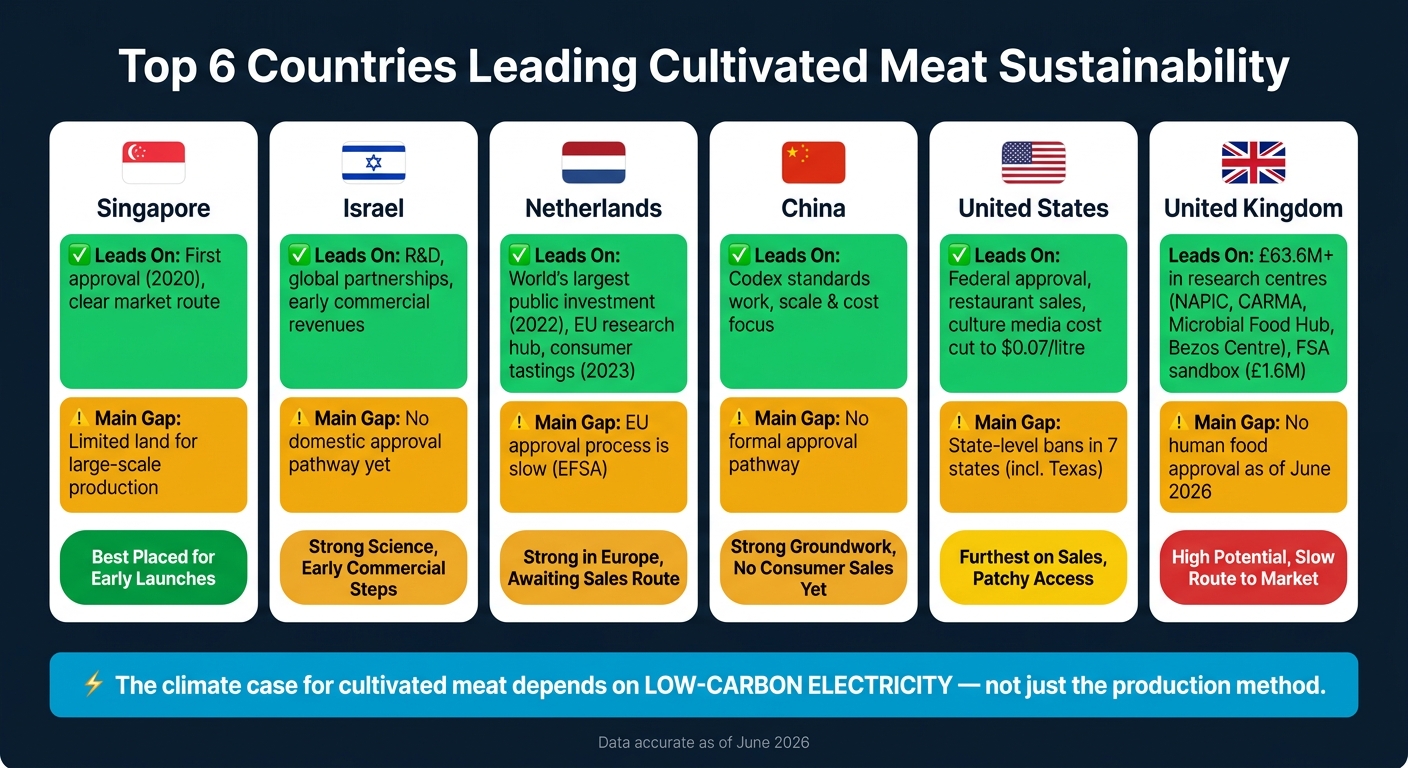
Top 6 Countries Leading Cultivated Meat: Strengths, Gaps & Sustainability Outlook
Lab-grown meat: Why are countries banning it? - The Global Story podcast, BBC World Service
Quick comparison
| Country | What it leads on | Main gap | Where it stands now |
|---|---|---|---|
| Singapore | First approval, clear route to market | Limited land for large production | Best placed for early launches |
| Israel | R&D, partnerships, early sales activity | No domestic approval path | Strong science base, early commercial steps |
| Netherlands | Public funding, research, tastings | EU approval process is slow | Strong in Europe, waiting for sales route |
| China | Standards work, scale focus, cost work | No formal approval path | Strong on groundwork, not consumer sales |
| United States | Federal approval, restaurant sales, cost cuts | State-level bans | Furthest along in sales, but patchy access |
| United Kingdom | Research centres, sandbox testing | No approval for human food yet | High potential, slow route to market |
My take: no country has everything in place yet. The race is now less about who talks first, and more about who can pair clear rules, cheap production, and clean power.
If you are comparing where cultivated meat may grow fastest next, these six countries set the pace.
1. Singapore
Singapore is out in front because it moved early on regulation and gave companies a plain, usable path to market. That matters. The country treats Cultivated Meat as part of its food security plan, not just a niche food idea.
Regulatory Progress
In 2020, Singapore became the first country to approve Cultivated Meat for sale, through the Singapore Food Agency's single-agency route [5]. That single-agency model gave companies a clear route to market [5].
Sustainability Policy Framing
Singapore presents Cultivated Meat as both a food security measure and a sustainability measure. The logic is simple: the country has limited land and relies heavily on food imports, so new ways to produce protein carry extra weight [5].
Public Investment and R&D
Singapore's pioneering 2020 approval helped attract about $847 million in global venture funding in 2023 [5].
Scale and Market Readiness
In June 2024, GOOD Meat began the first retail sale of Cultivated Meat at Huber's Butchery in Singapore, with GOOD Meat 3 priced at S$7.20 for 120 g [4]. GOOD Meat 3 uses a hybrid formulation - 3% cultivated chicken and 97% plant proteins - to keep costs manageable [4].
That said, scale is still the big hurdle. And there’s a catch: if production facilities run on fossil fuels, much of the carbon upside shrinks fast [5][6].
Singapore sets the benchmark on regulation, while the next countries are moving ahead through research, policy backing and scale-up.
2. Israel
Israel has built a strong Cultivated Meat ecosystem, with a clear focus on advanced R&D, work with global partners, and early commercial activity.
Regulatory Progress
Unlike Singapore’s approval-first approach, Israel is building its role through standards work and R&D. It has not yet approved domestic sales, but it is helping shape global standards through Codex. In June 2026, APAC-SCA, which includes Israeli companies, gained Observer status with the UN’s Codex Alimentarius Commission [7].
R&D and Commercialisation
Israel’s R&D base is already well known, and Cultivated Meat is part of that story.
Steakholder Foods Ltd. (Nasdaq: STKH) is a good example of how Israeli firms are pushing the tech forward. In 2024, the company reported its first commercial revenues. It also secured partnerships with Wyler Farm and Bondor Foods, and opened a Demonstration Centre for its 3D-printing technology. On top of that, it expanded overseas through a collaboration with Taiwan’s Industrial Technology Research Institute (ITRI) [2].
That early commercial activity sits alongside Israel’s effort to help shape the rules that will guide the sector.
Sustainability Policy Framing
Israel presents Cultivated Meat as part of a broader reform of the food system, with science-led development and harmonised regulation at the centre.
Scale and Market Readiness
Israel is starting to move from R&D into early commercialisation through premix products, which sell cultivated ingredients to processors. Large-scale production is still limited. The premix model brings in revenue and helps firms build ties across the industry, but major scale-up is still to come.
3. Netherlands
After Singapore’s early rule-setting and Israel’s R&D push, the Netherlands stands out for strong public backing and a solid research base.
Regulatory Progress
In July 2023, the Netherlands became the first country in Europe to allow controlled consumer tastings of Cultivated Meat. Full approval for commercial sales, though, is still pending [9].
Dutch firms are also shaping safety review work beyond their own borders. In March 2025, Mosa Meat was selected by the UK Food Standards Agency (FSA) as one of eight international participants in its £1.6 million "sandbox" programme, which aims to speed up safety assessments for Cultivated Meat products [3].
Public Investment and R&D
In 2022, the Dutch government announced the world’s largest public investment in Cultivated Meat [9]. That move helped position the country as Europe’s leading research hub for the field.
Sustainability Policy Framing
The Netherlands presents Cultivated Meat as part of its "protein transition" away from livestock systems that use large amounts of land and resources. Estimates suggest it could cut greenhouse gas emissions by up to 92% and land use by up to 95% compared with conventional beef [9].
Scale and Market Readiness
There has been solid progress, but the funding picture is still uneven. Mosa Meat raised €15 million in December 2025, while Meatable shut down after failing to secure more capital [9].
The Netherlands has the science and a strong funding track record. The sticking point is turning trials into full commercial sales, and giving that research base a clear path into the market.
sbb-itb-c323ed3
4. China
After Singapore moved early, China has taken a different route. Instead of opening the market first, it's pushing ahead with standards work and R&D.
China still doesn't have a formal approval pathway for Cultivated Meat.
Regulatory Progress
China is a member of the APAC Society for Cellular Agriculture (APAC-SCA). In June 2026, the group was granted Observer status at the Codex Alimentarius Commission, which gives regional stakeholders a formal channel to shape international food-safety standards for Cultivated Meat [7].
Alongside that, the APAC Regulatory Coordination Forum, co-led by the Good Food Institute APAC, has published white papers on cell lines and culture media. The aim is to help regulators decide what to review first and how to move approvals forward [7].
Public Investment and R&D
This standards work is tied to active R&D investment in China. A big part of that effort is focused on large-scale production and bringing costs down [1].
Sustainability Policy Framing
China's focus is clear: make Cultivated Meat scalable and affordable enough to support a more resilient protein supply. That groundwork also supports the broader goal of cutting land use and emissions compared with conventional meat production [1].
Scale and Market Readiness
The main bottleneck is still the lack of a formal approval pathway [7]. Without that, commercial readiness stays on hold.
So for now, China has influence over the regulatory groundwork, but it isn't yet shaping consumer sales.
5. United States
Unlike China, the US already has federal approval in place, but state rules are still holding sales back. Out of the six countries, the US has the strongest commercial push right now. Even so, federal approvals are being chipped away by state bans. The FDA and USDA have already cleared Cultivated Meat products for safety, including cultivated chicken and, more recently, Cultivated Meat products from seafood. In July 2025, San Francisco-based Wildtype launched its cultivated salmon at the restaurant Kann in Portland, Oregon. That made the US the first country to clear these products for sale [1][11].
Regulatory Progress
Federal approval is in place, but state bans are still blocking access to the market. As of June 2025, seven states, including Texas, had banned sales [1]. That leaves companies in an awkward spot: cleared at the top level, blocked in parts of the country.
US firms are also looking overseas for progress. BlueNalu, based in San Diego, was selected as one of eight international participants in the UK Food Standards Agency's two-year sandbox programme to assess the safety of its products for the UK market [3].
That patchy rulebook now sits alongside a rise in technical investment.
Public Investment and R&D
Money and research activity are picking up. Food System Innovations opened a $2 million lab in July 2026. Clever Carnivore cut culture-media costs to $0.07 per litre. Federal backing is also helping real-time AI monitoring for fermentation, with the aim of improving production efficiency and cutting waste [1][8].
Sustainability Policy Framing
Supporters point to large cuts in resource use. The case often made is up to 90% less land use and 70% less water use than conventional meat production [10][11]. But there’s a catch. Carbon savings depend heavily on the energy source behind production, and fossil-powered systems weaken that case.
Scale and Market Readiness
In the US, commercialisation has already moved into restaurant settings. The big problem is legal fragmentation. Producers still face uncertainty over where they can actually sell.
6. United Kingdom
The UK still hasn't approved Cultivated Meat for people to eat, but it is putting its own route in place. As of 30 June 2026, no UK Cultivated Meat products had been authorised for consumer sale [2]. So, while Singapore and the US moved ahead first on commercial sales, the UK is still building the system it wants to use at home.
Regulatory Progress
Since Brexit, the Food Standards Agency (FSA) has had room to shape its own approval process. In early 2025, the FSA launched a £1.6 million sandbox with eight companies to test what safety evidence is needed for approval [3]. The first group includes UK firms Hoxton Farms, Roslin Technologies and Uncommon Bio [3].
This matters for more than just regulation. If the UK can approve products faster, it has a better shot at linking that speed to lower-carbon production.
Public Investment and R&D
The UK has put public money behind several research centres working on the hardest parts of Cultivated Meat: scale, cost and production efficiency. These include:
- National Alternative Protein Innovation Centre (NAPIC) at the University of Leeds - £15 million in public funding, £38 million in total
- Cellular Agriculture Manufacturing Hub (CARMA) at the University of Bath - £12 million
- Microbial Food Hub at Imperial College London - £12.6 million
- Bezos Centre for Sustainable Protein at Imperial College London - £24 million [12][13]
CARMA, launched in 2023 and led by Professor Marianne Ellis, has a seven-year mission centred on large-scale fermenters and cheaper growth media [12]. NAPIC, formally launched in November 2024 at the University of Leeds, brings together more than 30 researchers and 150 industry partners [12][13].
In plain terms, these centres are trying to fix the biggest pain points in the sector: high costs, hard-to-scale systems and energy demand. The next test is whether all of this funding can help the UK move from lab support to faster approvals.
Sustainability Policy Framing
Agriculture makes up 11% of the UK's greenhouse gas emissions [2]. The Climate Change Committee has openly backed alternative proteins in its Seventh Carbon Budget, describing Cultivated Meat as a useful tool for hitting net-zero goals [2]. The government's Plan for Change also places Cultivated Meat within a low-carbon growth plan [3].
Scale and Market Readiness
On the commercial side, the UK is still at an early point. The first UK sale happened in pet food, not food for people, while the human food approval process carries on [2]. The FSA's sandbox is meant to cut approval time to about two years, but people in the sector have said that pace and funding will decide whether the UK can keep up [3].
"The sandbox will only be considered a success if the FSA also receives the support and funding to complete its assessments within faster timelines. Without this speed, it risks losing out on creating a competitive homegrown industry." - Jim Mellon, Executive Chairman, Agronomics [3]
The picture in the UK is pretty clear: strong public funding, weak market access. That tension stands out even more once you compare the UK with other leading markets.
How Each Country Compares: Strengths And Gaps
The six countries fall into two camps. Some are ahead on approval and consumer access. Others are stronger on research and production scale. No country has the whole package yet. Each one brings a different edge, and each one has a weak spot that could slow long-term progress on Cultivated Meat sustainability.
Singapore is ahead on consumer access and fast regulation, but its land limits domestic production scale. That makes it more of a pilot market than a major manufacturing hub. The UK sits at the other end of the spectrum. It stands out for research and regulatory planning, but it has moved to market more slowly than Singapore or the United States.
The table below shows how the six countries stack up on the factors that matter most for sustainability leadership.
| Country | Key Strengths | Key Constraints | Sustainability Outlook |
|---|---|---|---|
| Singapore | First-mover regulatory approval; high consumer acceptance | Limited domestic production scale due to land constraints | Likely to remain the global pilot market for new product launches |
| Israel | Strong R&D base; early commercial revenues through premix products; active global partnerships [2] | No domestic approval pathway yet; large-scale production still limited | Well placed to lead on technology if a clear approval route follows |
| Netherlands | Home to Mosa Meat, pioneer of the first cultivated burger; strong EU research ties [3] | Complex EU-wide regulatory process through EFSA [3] | Central to European technical progress if approvals speed up |
| China | Active standards work through Codex; focus on large-scale production and cost reduction [1][7] | No formal approval pathway; commercial readiness on hold [7] | Major influence over global standards, but consumer sales remain some way off |
| United States | Leading private R&D; culture media costs reduced to $0.07 per litre [1] | Political opposition and state-level bans in seven states, including Texas, as of June 2025 [1] | Will lead on price parity if political hurdles are resolved |
| United Kingdom | Strong academic research base; FSA sandbox speeding up safety assessments [3] | Slow regulatory timelines; agritech funding lags behind US and Asian rivals [3] | High potential for trusted leadership if approval speed improves |
As Jim Mellon, Executive Chairman of Agronomics, has noted:
"The country has proven over the last 12 to 15 months that we have the talent and the technology, and the next step to unleash its potential will be expediting and modernising its regulatory process." [3]
That leaves one big test: which country can match regulation with low-carbon energy at scale.
Conclusion
Across the six countries, the pattern is clear. Singapore leads on approvals, the United States leads on cost reduction, and the UK leads on regulatory design. The big test now is simple: which country can match approvals with low-carbon production at scale?
For the UK, the next step is whether progress on regulation turns into actual market access. One signal stands out. In July 2025, Gourmey became the first Cultivated Meat company to have an application validated by the UK's Food Standards Agency (FSA) and Food Standards Scotland (FSS) [1]. That points to movement in the UK towards faster approvals tied to carbon reduction and scale.
For consumer updates on UK approvals and product launches, Cultivated Meat Shop is a useful starting point.
FAQs
Why is low-carbon electricity important for Cultivated Meat sustainability?
Low-carbon electricity matters because cultivated meat production uses a lot of energy. Even if the sector becomes more efficient over time and is expected to use less energy than livestock farming, today’s bioreactor-based production still demands a large amount of power.
That’s why low-carbon electricity, including sources like solar, makes such a difference. It helps cut the sector’s carbon footprint and supports its long-term ability to operate with lower emissions.
Which country is closest to making Cultivated Meat widely available?
Singapore is widely seen as the country closest to making Cultivated Meat an everyday part of consumer life. It became the first nation to grant regulatory approval in 2020, and it has already opened the door to commercial sales of several products, including cultivated chicken and quail.
The United States, Israel and Australia have also authorised Cultivated Meat for human consumption. Even so, Singapore stays ahead because of its collaborative regulatory approach and the fact that these products are already available at retail level.
Why is the UK still behind on consumer approval?
In the UK, support for Cultivated Meat is still held back by caution and deep-rooted food habits. Many people remain wary of it, and there’s a strong pull towards the way food has always been bought, cooked and eaten.
That hesitation sits alongside genuine interest. People do see the appeal, especially when it comes to lower impact on the planet and better outcomes for animal welfare. But those upsides haven’t cleared the main hurdles. Worries about safety, health effects, and plain, standard labelling still make many consumers pause.
Cultivated Meat Shop works to build trust by offering clear, educational resources that explain the topic in a direct and open way.


